
How to Optimize for E-E-A-T: 2026 Trust Playbook
A step by step E-E-A-T guide built from Google's rater guidelines: score your pages, capture first-hand evidence, fix trust debt, and earn real authority.
- ✓The Nine Doubts Framework & Asymmetric Trust Mechanics
- ✓The 5-Level Evidence Ladder (L0 Bare Claims to L4 Proprietary Artifacts)
- ✓YMYL Harm Tiers (T0 to T3) & E-E-A-T Coverage Matrix
- ✓The 90-Day Trust Engineering Execution Roadmap
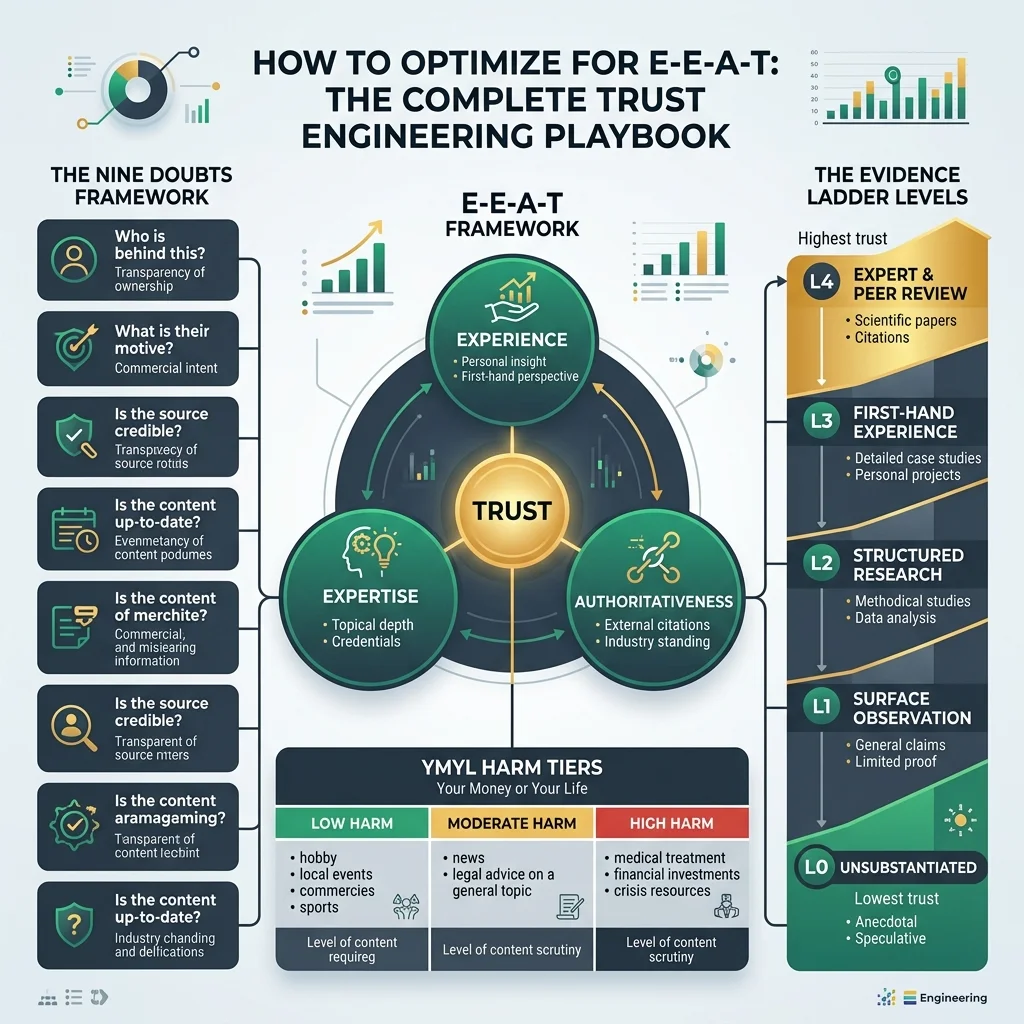
Quick answer: You cannot install E-E-A-T like a plugin. You earn it by making three things verifiable on every page: who created it, how it was created, and why a reader should believe the claims. Practically, that means named authors with real off-site footprints, first-hand artifacts such as screenshots, photos, raw numbers and test logs, honest sourcing, a clean site identity (About, Contact, ownership, policies), and independent corroboration from outside your own domain. Trust sits at the center of the model, and trust is lost far faster than it is built.
How to optimize for E-E-A-T in 10 steps
- Learn what the four letters actually mean in Google's own words, and what they are not.
- Triage your site by harm risk, because YMYL pages need far more proof than a recipe post.
- Score your top pages with a repeatable scorecard instead of guessing.
- Fix site-level identity first: About, Contact, ownership, and consistent entity details.
- Build a real author system with bylines, bios, reviewers, and off-site footprints.
- Install an experience capture loop so first-hand proof exists before writing starts.
- Convert expertise into verifiable content: methodology blocks, sourcing, expert review.
- Earn authoritativeness off-site, because that letter is never awarded by your own website.
- Clear your trust debt: the small unresolved doubts that quietly cancel good content.
- Disclose automation honestly and measure trust with proxies, not a fictional score.
What E-E-A-T actually is
E-E-A-T stands for Experience, Expertise, Authoritativeness, and Trust. Three of those letters are old. The first E is the newest: Google added Experience to the framework in December 2022, asking whether content shows it was produced with some degree of first-hand involvement, such as actually using a product, visiting a place, or communicating something the writer personally lived through (https://developers.google.com/search/blog/2022/12/google-raters-guidelines-e-e-a-t).
The definitions that matter come from Google's own quality rater guidelines, where E-E-A-T is covered in section 3.4 of the General Guidelines document (https://static.googleusercontent.com/media/guidelines.raterhub.com/en//searchqualityevaluatorguidelines.pdf). Stripped to essentials:
| Letter | The question being asked | What resolves it |
|---|---|---|
| Experience | Does the creator have the necessary first-hand or life experience for this topic? | Evidence of doing the thing: photos, screenshots, receipts, logs, before and after data |
| Expertise | Does the creator have the necessary knowledge or skill for this topic? | Credentials, track record, demonstrable competence appropriate to the subject |
| Authoritativeness | Is the creator or site known as a go-to source for this topic? | What independent parties say and cite, not what you claim |
| Trust | Is the page accurate, honest, safe, and reliable? | Everything above, plus transparency, disclosure, and the absence of unresolved doubts |
Google's guidance is unusually direct about the hierarchy: of these aspects, trust is the most important, and the others contribute to trust. Content does not have to demonstrate all four. Some content is helpful because of experience, other content is helpful because of expertise (https://developers.google.com/search/docs/fundamentals/creating-helpful-content).
The rater guidelines make the same point with a memorable example: an untrustworthy page has low E-E-A-T no matter how experienced, expert, or authoritative it appears, because a financial scam is still a scam even when it is run by a highly experienced scammer who is widely considered the go-to expert on running scams.
Read that twice. It means E, E, and A are inputs. Trust is the output. Optimizing for E-E-A-T is therefore not a content-marketing exercise. It is trust engineering.
The three sentences most people skip
These three official statements should shape your entire strategy, and most articles on this topic quietly ignore all three.
- E-E-A-T is not a ranking factor. Google states that while E-E-A-T itself is not a specific ranking factor, using a mix of factors that can identify content with good E-E-A-T is useful (https://developers.google.com/search/docs/fundamentals/creating-helpful-content). There is no score, no dial, no field in an index called eeat_score that you can raise.
- Rater scores do not move your rankings. Quality raters evaluate whether ranking changes are working. Their ratings are used in aggregate to measure algorithm performance, not to promote or demote individual pages.
- YMYL gets extra weight. Google gives more weight to content aligned with strong E-E-A-T for topics that could significantly impact health, financial stability, or safety of people, or the welfare or well-being of society. Those are Your Money or Your Life topics.
So why bother? Because the rater guidelines are the clearest published description of what Google's automated systems are being tuned to approximate. You are not optimizing for raters. You are optimizing for the same qualities the raters were hired to recognize, on the assumption that the algorithms are chasing the same target. That distinction keeps you from doing dumb things like adding a fake medical reviewer to a shoe review.
What E-E-A-T is not
Before any tactics, clear the underbrush. Every item below wastes budget.
| Popular belief | Reality |
|---|---|
| There is an E-E-A-T score you can raise | There is no score. There is a mix of signals approximating perceived trustworthiness |
| Author schema grants authority | Structured data helps machines parse an entity. It does not confer credibility. A bio with no external footprint proves nothing |
| Adding a bio to thin content fixes it | A byline on a page with nothing original raises the question of who to blame, not the quality |
| Longer content signals expertise | Google explicitly says there is no preferred word count. Writing to a word count is listed as a warning sign |
| E-E-A-T applies uniformly to every page | Different page types and topics need different combinations. A humor site does not need detailed contact information |
| YMYL means an entire industry | Harm potential attaches to topics and queries, not to whole verticals. A finance site's careers page is not YMYL |
| A medical reviewer byline is always good | A reviewer who did not review anything is a fabricated trust signal, which is a trust liability |
| E-E-A-T replaced links and relevance | It sits alongside relevance, links, and page experience. It is not a substitute for any of them |
The useful reframe: you are not adding E-E-A-T to a page. You are removing reasons to doubt it, and adding things a skeptic could verify.
The Nine Doubts framework
Here is the mental model I use instead of the four letters, because the letters describe what an evaluator measures, not what a reader feels.
Every visitor arrives carrying a silent list of doubts. Each doubt either gets resolved by something on the page or it stays open. Open doubts are what low trust actually is.
| Doubt | The reader's unspoken question | The artifact that closes it |
|---|---|---|
| D1 Identity | Who wrote this? | Named byline linking to a real author page |
| D2 Experience | Have they actually done this themselves? | First-hand artifacts: screenshots, photos, raw output, dated logs |
| D3 Competence | Are they qualified to tell me this? | Relevant credentials, work history, or a visible body of work |
| D4 Incentive | What do they gain if I follow this advice? | Plain disclosure of affiliate, sponsor, ownership, and product ties |
| D5 Currency | Is this still true today? | Meaningful last-updated dates plus a changelog of what changed |
| D6 Verifiability | Can I check the numbers myself? | Named sources with links, methodology, sample sizes, dates |
| D7 Accountability | Who is behind this website? | About page, real contact routes, legal entity, ownership and funding |
| D8 Consequence | What if this advice is wrong for me? | Stated limits, exceptions, risk notes, when to consult a professional |
| D9 Corroboration | Does anyone independent vouch for them? | Off-site mentions, citations, reviews, expert quotes, coverage |
Two rules make this operational.
Rule 1: doubt is asymmetric. One unresolved doubt can cancel five resolved ones. A page with a great author bio, deep research, and clean design still loses when an undisclosed affiliate link surfaces. Trust behaves like subtraction, not addition.
Rule 2: baseline varies by arrival path. A visitor from a branded search arrives with a high starting balance. A visitor from an AI answer citation arrives with a medium balance and low patience. A visitor from a cold social link arrives near zero. Pages that receive cold traffic need to close more doubts, faster, and higher up the page.
Perceived trust = arrival baseline
                + closed doubts (verifiable artifacts)
                - open doubts (unresolved questions)
                - contradictions (claims that conflict with observable facts)
Run this on a page you own right now. Nine questions, honest answers. Most sites discover that they have been polishing D3 (credentials) while leaving D2, D4, D6, and D9 wide open.
The Evidence Ladder: rank proof by how hard it is to fake
The single biggest quality difference between content that survives core updates and content that does not is the kind of evidence it carries. Not the amount. The kind.
Rate every claim on your page against this ladder. The right-hand column is the honest question: how easily could a competitor with no experience produce the same thing?
| Level | Evidence type | Example | Fakeable in minutes? |
|---|---|---|---|
| L0 | Bare assertion | "This is the best approach for most businesses" | Yes, trivially |
| L1 | Borrowed citation | "Studies show 70 percent of buyers do X" with a link | Yes, anyone can cite |
| L2 | Synthesized expertise | An original explanation, decision tree, or comparison built from real knowledge | Partly, with skill |
| L3 | First-hand demonstration | Annotated screenshots of the actual settings, photos of the product in use, your test output | No, requires doing it |
| L4 | Proprietary artifact | Your own dataset, longitudinal record, published test method, free tool, client outcome with numbers | No, requires investment |
The 3-plus rule: any page that competes for money, or that touches health, finance, safety, or legal outcomes, needs at least one L3 or L4 asset that is impossible to produce without having done the work. Informational support pages can live at L2 if they are genuinely original explanations.
Why this beats generic advice like "add first-hand experience": it is measurable. Open a page, list its claims, label each with a level, and count. If the page is entirely L0 and L1, no author bio will save it, because you have published a rewrite of other people's knowledge. The rater guidelines assess main content quality by the effort, originality, and skill that went into creating it, and ask whether the content offers unique material not available on other sites, including whether you are the original source.
Turning L0 claims into L3 evidence
A practical conversion table you can apply to almost any niche.
| Weak claim (L0) | Same point at L3 or L4 |
|---|---|
| "Page speed affects conversions" | Your own before and after: field data screenshots, the exact change made, revenue delta over 30 days |
| "This tool is easy to set up" | A dated screenshot sequence of your actual setup, including the step where it broke and how you fixed it |
| "Most clients need three months to see results" | A table of your last 12 engagements: start month, first measurable change, outcome, with identities anonymized |
| "Consult a professional before starting" | The two-question test you use to decide whether a case needs a professional, drawn from cases you handled |
| "Pricing varies by provider" | Your own price survey with collection date, method, sample, and the raw table |
Notice that none of these require a bigger budget. They require recording what you already do.
YMYL triage: decide how much proof each page needs
Optimizing every page to the same standard is how teams burn six months and improve nothing. Triage first.
Google describes YMYL as topics that could significantly impact health, financial stability, or safety of people, or the welfare or well-being of society (https://developers.google.com/search/docs/fundamentals/creating-helpful-content). Harm potential is a spectrum, not a switch, so treat it as tiers.
| Tier | Description | Examples | Minimum evidence | Review process |
|---|---|---|---|---|
| T0 | No plausible harm | Hobby guides, entertainment, opinion, humor | L2 originality, named author | Self review |
| T1 | Minor harm, wasted money or time | Software comparisons, gear reviews, productivity advice | One L3 artifact, disclosure of ties | Peer review |
| T2 | Significant financial, legal, or health impact | Loans, insurance, tax, supplements, parenting, career decisions | L3 plus named credentials, sources dated | Qualified reviewer named on page |
| T3 | Severe or irreversible harm | Medical treatment, drug interactions, self-harm, legal jeopardy, structural safety | L3 or L4, expert authorship, citations to expert consensus | Documented expert review, versioned updates |
For T2 and T3 pages, the rater guidelines are explicit that accuracy and consistency with well established expert consensus matters. That is a real constraint. On those topics, being contrarian and original is a liability rather than an asset. Save your original angles for methodology, examples, and clarity, not for disputing consensus.
Practical triage exercise: export your top 100 pages by impressions, add a tier column, and sort. You will typically find that fewer than 20 pages need T2 or T3 treatment. Those 20 get the expert review budget. The rest get named authors and one real artifact each.
The E-E-A-T Coverage Matrix by page type
Different page types need different letters. The rater guidelines acknowledge this directly: you should consider the purpose, type, and topic of the page, then ask what would make the creator a trustworthy source in that context. Pages with user-generated content may even let authors identify themselves with an alias or username only, and personal sites may reasonably omit a home address.
Here is the mapping I use in audits. Weight is out of 10 across the four letters.
| Page type | Experience | Expertise | Authoritativeness | Trust | The one thing that decides it |
|---|---|---|---|---|---|
| Product review | 5 | 2 | 1 | 2 | Proof you physically used it |
| How-to tutorial | 3 | 4 | 1 | 2 | Screenshots of the real process, including failure states |
| Medical or health explainer | 1 | 4 | 2 | 3 | Named qualified reviewer plus consensus alignment |
| Financial guidance | 1 | 4 | 2 | 3 | Credentials, jurisdiction, disclosure of incentives |
| Local service page | 3 | 2 | 2 | 3 | Verifiable business identity, reviews, real service area |
| Software comparison | 4 | 2 | 1 | 3 | Hands-on testing plus transparent affiliate disclosure |
| News reporting | 2 | 2 | 3 | 3 | Sourcing, corrections policy, publication accountability |
| Original research | 2 | 3 | 3 | 2 | Method, sample, raw data availability |
| Opinion or essay | 3 | 2 | 3 | 2 | A named voice with standing to hold the opinion |
| Forum or UGC thread | 4 | 1 | 1 | 4 | Moderation quality and abuse controls |
| Free tool or calculator | 2 | 3 | 1 | 4 | Correct math, stated assumptions, privacy handling |
| Ecommerce product page | 1 | 1 | 2 | 6 | Returns, shipping, payment clarity, real contact routes |
Use it as a budget allocator. If you sell a service locally, hiring a PhD to review your blog is the wrong purchase. Getting 30 recent, specific reviews and a verifiable business identity is the right one.
The E-E-A-T Scorecard: make trust auditable
Opinions do not survive contact with a client or a boss. Scores do. Rate each page 0 to 3 per dimension.
Experience (0 to 3)
- 0: No indication anyone involved has done the thing.
- 1: Claims of experience with no artifacts.
- 2: Some first-hand detail, generic visuals, stock imagery.
- 3: Unmistakable artifacts a non-practitioner could not produce.
Expertise (0 to 3)
- 0: No author, or an author with no relationship to the topic.
- 1: Named author, no relevant background shown.
- 2: Relevant background stated on an author page.
- 3: Background appropriate to the harm tier, plus visible depth in the writing itself.
Authoritativeness (0 to 3)
- 0: Nobody outside the site references this site or author for this topic.
- 1: A handful of incidental mentions.
- 2: Recurring independent references, quotes, or citations in the topic area.
- 3: Recognized as a go-to source, cited by peers, referenced without prompting.
Trust (0 to 3)
- 0: Open doubts on identity, incentive, or accuracy. Any deceptive element.
- 1: Basic identity present, gaps in disclosure, sourcing, or currency.
- 2: Identity, disclosure, sourcing, and dates all handled.
- 3: All of the above, plus visible accountability: corrections, changelogs, easy contact, honest limits.
Weighted score = (E1 x wE) + (E2 x wX) + (A x wA) + (T x wT)

Weights by tier (out of 1.0)
  T0: E .30  X .20  A .10  T .40
  T1: E .30  X .20  A .15  T .35
  T2: E .15  X .30  A .20  T .35
  T3: E .10  X .35  A .20  T .35

Pass thresholds (percentage of maximum)
  T0 pass 55   T1 pass 65   T2 pass 80   T3 pass 90

Hard fail rules, regardless of total
  Trust scored 0 is an automatic fail
  T2 or T3 page with Expertise below 2 is an automatic fail
  Any page with an undisclosed commercial incentive is an automatic fail
Two details make this useful rather than decorative. First, trust carries the heaviest weight at every tier, matching Google's own hierarchy. Second, the hard fail rules stop teams from averaging their way past a fatal problem, which is exactly how sites with beautiful author pages still get hit.
Run the scorecard on your 20 highest-value pages, then again after 90 days. That delta is your real report.
Step 1: Fix site-level identity before touching content
Raters are instructed to research the reputation of the website and, when the site is not the primary creator of the content, the reputation of the content creator as well. Their starting point is what the site says about itself, beginning with the About page and creator profiles.
This is the cheapest, highest-leverage work in E-E-A-T, and it is skipped constantly because it produces no keyword rankings on its own. It changes how every other page is judged.
The seven pages that carry site-level trust
| Page | What it must answer | Common failure |
|---|---|---|
| About | Who runs this, since when, why, and with what standing | A paragraph of mission language with no humans in it |
| Contact | How a real person reaches a real person | A form only, no email, no phone, no address, no response time |
| Team or Authors | Who produces the content and what qualifies them | Stock photos, or "written by the editorial team" |
| Editorial policy | How content is researched, reviewed, and updated | Missing entirely on sites making health and money claims |
| Corrections policy | What happens when you are wrong | Absent, so errors get silently deleted |
| Disclosures | Affiliate, sponsorship, ownership, and funding relationships | Buried in a footer nobody reads |
| Legal and privacy | Entity name, jurisdiction, data handling, terms | Boilerplate with the wrong company name still in it |
The rater guidelines note that the expected level of contact detail depends on the site's purpose. A shopping site is expected to make payment, exchange, and customer service information findable. A humor site is not held to the same standard. Match the expectation for your category, and exceed it where money changes hands.
The entity consistency check
One of the fastest trust killers is inconsistency across the web. Machines and skeptical humans both notice.
Collect these values and confirm they match everywhere they appear:
- Legal entity name and trading name
- Registered address and any service address
- Phone number and support email domain
- Founding year and founder names
- Credentials and licence numbers, with issuing bodies
- Social and professional profile URLs
Then check them against: your website footer, About page, Google Business Profile, LinkedIn company page, invoices, review platform listings, industry directories, and any press page. A different founding year on LinkedIn than on your About page is exactly the kind of small contradiction that suppresses trust without ever showing up in a report.
Organization identity in structured data
Structured data does not create credibility, but it removes ambiguity about which real-world entity you are. Represent it once, sitewide, and keep it factual. Shown here as fields rather than raw JSON so you can map them into whatever your platform uses.
type: Organization
name: Your Legal Trading Name
url: https://example.com/
logo: https://example.com/logo.png
foundingDate: 2019-04-01
address:
  type: PostalAddress
  streetAddress: Full street address
  addressLocality: City
  addressRegion: State or region
  postalCode: Postal code
  addressCountry: Country code
contactPoint:
  type: ContactPoint
  contactType: customer support
  email: support@example.com
  telephone: Full international format
sameAs:
  - https://www.linkedin.com/company/your-company
  - https://www.crunchbase.com/organization/your-company
  - https://your-industry-association.org/members/your-company
The sameAs values matter more than the rest. They are the links between your claimed identity and identities that other parties control, which is the closest structured data comes to corroboration.
Step 2: Build an author system, not author bios
Google is explicit here: it strongly encourages adding accurate authorship information, such as bylines, to content where readers might expect it, and asks whether bylines lead to further information about the author, giving background about them and the areas they write about (https://developers.google.com/search/docs/fundamentals/creating-helpful-content).
Note the two conditions most sites fail. The information must be accurate, and the byline must lead somewhere useful. A fabricated persona with a generated headshot satisfies neither and converts a trust asset into a liability.
The author page that actually works
Eight elements, in priority order:
- Real name, and a real photo of that person.
- A one-line statement of standing that is specific to a topic, not a job title. "Twelve years running paid media for direct-to-consumer brands" beats "passionate marketing professional".
- Evidence of the work: employers, clients where permitted, projects, tools built, papers, talks.
- Credentials with issuing bodies and years, only where they are relevant.
- Off-site profile links that the author controls elsewhere, so a reader can triangulate.
- Topic scope, stated plainly: what this person writes about and what they do not.
- A complete list of their posts on your site, linked in both directions.
- A contact route, even if it is a form that routes to them.
Person fields for an author page
type: Person
name: Full Name
jobTitle: Role that matches reality
worksFor: Your Legal Trading Name
description: One or two sentences of topic-specific standing
knowsAbout:
  - Specific subtopic one
  - Specific subtopic two
alumniOf: Institution, only if true and relevant
sameAs:
  - https://www.linkedin.com/in/profile
  - https://github.com/username
  - https://independent-publication.com/author/name
Who, How, and Why as a page-level habit
Google frames self-assessment around three questions: who created the content, how it was created, and why it was created (https://developers.google.com/search/docs/fundamentals/creating-helpful-content). Turn that into a small provenance block you place near the top or bottom of substantial pages.
Who:  Written by Priya Raman, who has managed HVAC service dispatch for 9 years.
How:  Based on 240 service calls logged between March and July 2026, plus
      manufacturer specifications for the four systems compared.
Why:  Homeowners kept asking us which repair is worth doing on a 12-year-old
      unit, and no existing guide showed the actual cost thresholds.
Reviewed by: Daniel Osei, licensed mechanical contractor, licence 448192.
Updated: 14 August 2026. Changelog at the bottom of this page.
That block is roughly 60 words and closes five of the Nine Doubts at once. It is the highest return-per-word element you can add to a page.
When reviewer bylines help and when they hurt
Reviewer bylines are heavily oversold. Use this rule:
- Add a reviewer when the topic is tier T2 or T3, the reviewer genuinely read and approved the content, and their qualification is verifiable.
- Do not add a reviewer when the review is nominal, when the reviewer's credential is unrelated to the claim, or when you cannot describe what the review consisted of.
If you use reviewers, publish the review standard: what they check, what authority they have to block publication, and how often content is re-reviewed. An unexplained "medically reviewed" stamp asks the reader to trust a process they cannot see.
Step 3: Install an experience capture loop
This is the section most guides cannot write, because they have no first-hand experience of anything and therefore cannot explain how to record it.
The core problem: experience cannot be added in the editing phase. If nobody photographed the installation, took the screenshot, or saved the raw numbers, the writer's only options are to fabricate or to stay vague. Both destroy trust. So the fix belongs upstream, in operations.
The capture protocol
Build a standing habit for anyone in your organization who does the actual work.
| Trigger | Capture | Where it goes |
|---|---|---|
| Any client engagement kickoff | Baseline metrics screenshot, dated | Evidence folder, engagement subfolder |
| Any tool or product first use | Setup screenshots including errors, plus time taken | Evidence folder, tool subfolder |
| Any physical job or site visit | 6 to 10 photos, before, during, after, plus one problem shot | Evidence folder, job subfolder |
| Any test or experiment | Raw output file, method notes, sample size, date range | Evidence folder, test subfolder |
| Any support conversation with a good question | The verbatim question, anonymized | Question log |
| Any surprising result | One paragraph written same day, while the reasoning is fresh | Insight log |
Naming convention that keeps this usable a year later:
YYYY-MM-DD_topic_type_shortdescription
2026-08-14_hvac_photo_condenser-coil-corrosion.jpg
2026-08-14_hvac_data_240-service-calls-summary.csv
2026-07-02_analytics_screenshot_consent-mode-setup-error.png
Density target
A working rule from auditing hundreds of pages: aim for one original artifact per 500 words on competitive pages, and never publish a money page with zero. An artifact is a screenshot you took, a photo you shot, a chart from your own numbers, a quoted result, or a documented method. Stock photography, vendor screenshots, and AI illustrations do not count, because they prove nothing about you.
The question log advantage
The question log deserves special attention because it produces information gain that competitors structurally cannot copy. Competitors can read the same sources you read. They cannot read the questions your customers asked you. A page built around 12 real questions from your inbox will contain sections nobody else thought to write, which is exactly what Google's self-assessment asks about: does the content provide insightful analysis or interesting information beyond the obvious (https://developers.google.com/search/docs/fundamentals/creating-helpful-content).
Step 4: Turn expertise into something a stranger can verify
Expertise is invisible until it is expressed as structure, precision, and stated limits. Three techniques carry most of the weight.
The methodology block
Any page containing numbers, rankings, comparisons, or recommendations should carry a short method statement. It is the difference between a claim and a finding.
How we produced this comparison
  Products tested: 7, purchased at retail between 4 and 22 June 2026
  Test period: 6 weeks of daily use in a 4-person household
  Measured: setup time, noise at 1 metre, energy draw, filter cost per year
  Instruments: consumer sound meter, plug-in energy monitor, manufacturer specs
  Not tested: long-term durability beyond 6 weeks, commercial-scale use
  Funding: units purchased by us. No vendor provided samples or payment.
  Conflicts: none. We hold no affiliate relationship with any brand listed.
That block also closes D4 and D6. Write the "not tested" line honestly. Admitting the limits of your work is one of the strongest trust signals available, and almost nobody does it.
Precision markers
Experts write differently, and the differences are copyable habits rather than talent:
- Numbers with units and dates. "Around 14 fields" beats "a lot of fields". "Measured in June 2026" beats "recently".
- Named exceptions. "This fails when the property is tenanted" shows you have hit the edge case.
- Decision thresholds. "Replace rather than repair once the quote passes 40 percent of replacement cost" is expertise. "It depends on your situation" is not.
- Order of operations. Experts know what to do first and why. Sequencing is knowledge.
- Costs of being wrong. Stating the downside shows you have paid it.
- Disagreement handled fairly. Where practitioners genuinely disagree, say so and explain both positions.
Sourcing that survives scrutiny
For tier T2 and T3 content, accuracy and consistency with well established expert consensus is part of how quality is judged. So:
- Cite primary sources, not aggregators quoting aggregators. Trace every statistic to the organization that produced it.
- Include the date of the source, not just the link. A 2019 study presented as current is a factual error waiting to happen.
- State sample sizes and populations when quoting research, so readers can judge applicability.
- Never cite a number you have not personally opened and read in context.
- If your claim conflicts with consensus on a high-harm topic, either drop it or clearly frame it as a minority position with reasoning.
Google's self-assessment includes a blunt question: does the content have any easily-verified factual errors? On high-harm topics, one is enough to justify distrusting everything else on the page.
Step 5: Earn authoritativeness, which never lives on your own site
This is where most E-E-A-T programs quietly stall. Experience and expertise you can produce. Trust you can engineer. Authoritativeness is granted by other people.
The rater guidelines instruct evaluators to consider both what the site and creators say about themselves and what others say about them, looking for independent reviews, references, news articles, and other credible sources, and to research reputation for both the site and the content creator. Nothing on your own domain answers that question.
Run reputation research on yourself
Do exactly what an evaluator would do, and write down what you find. Search each of these and read the first two pages of results:
- Your brand name alone
- Brand name plus reviews
- Brand name plus complaints
- Brand name plus scam or fraud
- Brand name plus lawsuit or refund
- Each author's full name alone
- Each author's name plus your topic
- Your brand name inside an AI assistant, asked as "what do you know about X and are they credible"
The output is a one-page reputation file: what a stranger learns about you in five minutes, ranked by how prominent it is. Most teams have never done this and are shocked by what ranks.
| Finding | Interpretation | Action |
|---|---|---|
| Nothing exists at all | You have no authority signal, not a clean one | Build a corroboration base before expecting rankings on competitive topics |
| Only your own properties rank | Self-reference loop | Pursue third-party mentions, not more owned content |
| Negative results in the top 10 | An open D9 doubt at scale | Resolve substantively, then earn positive coverage. Do not attempt suppression |
| Mentions exist but are unlinked | Value left on the table | Contact publishers, offer better data, request attribution |
| Strong mentions in adjacent topics only | Authority mismatch | Publish and pitch specifically in the topic you want to rank for |
The corroboration map
Rank sources of authority by how much they actually shift perception, and stop treating all links as equal.
| Type of corroboration | Weight | How to earn it |
|---|---|---|
| Independent expert cites your original data | Highest | Publish original research worth citing |
| Recognized industry body lists or accredits you | Very high | Meet the standard, apply, maintain it |
| Practitioners recommend you unprompted in communities | Very high | Be genuinely useful in public over time |
| Journalists quote you as a named source | High | Be reachable, fast, quotable, and specific |
| Peers link to your method or tool | High | Build something reusable |
| Conference or podcast appearances in your field | Medium | Pitch with a specific, evidenced angle |
| Reviews on platforms you do not control | Medium | Systematic collection, never gated |
| Directory and citation listings | Low | Accurate, consistent, and complete |
| Paid placements and sponsored posts | Near zero for trust | Useful for reach, not for credibility |
A practical target for a small business: three unprompted third-party references in your specific topic per quarter. That is slow, and it compounds, and there is no shortcut that survives.
The thing to avoid: borrowing someone else's authority
Google now has a named spam policy for this. Site reputation abuse is publishing third-party content on a host site mainly because of the host's already-established ranking signals, so the content ranks better than it could on its own (https://developers.google.com/search/docs/essentials/spam-policies). Examples include a medical site hosting third-party "best casinos" pages and a news site hosting white-label coupon pages.
Importantly, hosting third-party content is not itself a violation. Editorial columns, opinion pieces, syndicated news, forums, comment sections, and native advertising shared genuinely with readers are all listed as acceptable. The line is intent: are you publishing this for your audience, or renting your domain's reputation to a stranger?
To learn how to earn real, authoritative editorial links without manipulative tactics or reputation abuse, follow our Quality Backlinks Guide.
Step 6: Clear your trust debt
Trust debt is the accumulated set of small unresolved doubts across a site. Each item looks minor. Together they explain why a technically clean site with decent content stays stuck.
For a concrete, real-world teardown of resolving trust debt and rehabilitating a domain flagged as spam, read our Solea Academy Penalty Recovery Case Study. (You can also run a quick diagnostic with our Free Technical SEO Audit Tool or follow our 12-Step SEO Audit Checklist to verify underlying crawl health).
Here is the register I run in audits, with severity. Work top down.
| Severity | Trust leak | Fix |
|---|---|---|
| Critical | Undisclosed affiliate, sponsor, or ownership relationship | Disclose prominently, above the first commercial link |
| Critical | Fabricated authors, credentials, reviews, or testimonials | Remove entirely. There is no partial fix |
| Critical | Claims that contradict expert consensus on high-harm topics | Rewrite or unpublish |
| Critical | No working contact route on a site that takes money | Add real routes with stated response times |
| High | Bulk-generated pages with no added value | Consolidate or remove, and stop the process producing them |
| High | Statistics with no source, or sourced to a dead link | Trace to primary sources or delete the claim |
| High | Dates changed to look fresh without substantive updates | Stop. Google names this explicitly as a warning sign |
| High | Byline of "admin", "team", or nothing at all on substantive content | Assign real named authors |
| Medium | Testimonials with no name, company, or verifiable detail | Get permission for specifics, or remove |
| Medium | Policy pages containing another company's name or wrong jurisdiction | Rewrite. This signals the whole site is a template |
| Medium | Reviews gated so only happy customers can post | Remove gating. Platforms and readers both punish it |
| Medium | Aggressive interstitials, autoplay, or ad density that buries content | Reduce. Page experience is part of trust |
| Medium | Outdated screenshots of interfaces that have since changed | Recapture, and date every screenshot |
| Low | No corrections or changelog practice | Add a short changelog to substantial pages |
| Low | Inconsistent entity details across profiles | Normalize using the entity consistency check |
The pattern to internalize: almost every critical item is about honesty, not effort. You can outwork a competitor on research and still lose to them because your affiliate relationship is hidden and theirs is disclosed in the first paragraph.
Step 7: Handle AI and automation honestly
Google's position on AI content has been consistent and is more permissive than the panic suggests, with one hard boundary.
The permission: ranking systems aim to reward original, high-quality content demonstrating E-E-A-T, however it is produced (https://developers.google.com/search/blog/2023/02/google-search-and-ai-content).
The boundary: using generative AI to produce many pages primarily to manipulate rankings is scaled content abuse, which is when many pages are generated mainly to manipulate rankings rather than help users, typically producing large amounts of unoriginal content with little value, no matter how it is created (https://developers.google.com/search/docs/essentials/spam-policies). Google's guidance on generative AI content points directly at the rater guidelines sections on scaled content abuse and on main content created with little to no effort, originality, or added value (https://developers.google.com/search/docs/fundamentals/using-gen-ai-content).
So the question is never "did AI write this". It is "does this page contain anything that required a human to have done something".
The disclosure rule
Google's own framing: AI or automation disclosures are useful for content where someone might think "how was this created", and you should consider adding them when it would be reasonably expected. The suggested questions are whether the use of automation is self-evident to visitors, whether you provide background on how it was used, and whether you explain why automation was useful.
A workable standard:
| Use of AI | Disclose? | Example wording |
|---|---|---|
| Research assistance, outlining, editing your own draft | No | Not needed |
| AI-assisted drafting of a human-reviewed article | Optional, recommended on YMYL | "Drafted with AI assistance, then verified and edited by the named author" |
| AI-generated summaries or translations at scale | Yes | "Summaries are machine-generated from the source article and spot-checked weekly" |
| Programmatic pages built from your own dataset | Yes | "Pages are generated from our licensed dataset, last refreshed August 2026, method described here" |
| Fully automated publishing with no human review | Do not publish | There is no disclosure that fixes this |
The human-contribution test
Before publishing anything AI helped produce, require at least one affirmative answer:
- Does it contain data, testing, or examples we generated ourselves?
- Does it contain a judgment or recommendation a named person will stand behind?
- Does it answer a question we heard from real customers?
- Does it correct or improve on what already ranks, in a way we can point to?
- Would we defend every factual claim in it if challenged publicly?
If the honest answer to all five is no, the page is a candidate for scaled content abuse regardless of how well written it reads.
Step 8: Let page experience carry its share of trust
Trust is partly aesthetic and behavioral, and Google treats it as its own layer. Its page experience guidance asks whether pages have good Core Web Vitals, are served securely, display well on mobile, avoid excessive ads that distract from or interfere with the main content, and avoid intrusive interstitials (https://developers.google.com/search/docs/appearance/page-experience). Its guidance for AI experiences makes the same point from the user's side: even the best content disappoints when the page is cluttered and hard to navigate (https://developers.google.com/search/blog/2025/05/succeeding-in-ai-search).
Nielsen Norman Group's research on trust and credibility in commerce interfaces points the same direction: credibility is assembled from many small signals, and users abandon when required information is hidden or effort feels unjustified (https://www.nngroup.com/reports/ecommerce-ux-trust-and-credibility/).
A short checklist that resolves most of it:
- Main content starts above the fold, before the first ad unit.
- No layout shift after the page settles, especially from injected ads.
- No modal within the first 15 seconds or first scroll depth on informational pages.
- Author, date, and sources visible without hunting.
- Tables and code readable on a 390 pixel wide screen.
- Ad density that a reasonable person would not describe as aggressive.
- Working search, working navigation, no dead internal links.
- HTTPS everywhere, with no mixed content warnings.
Step 9: Reviews are the trust layer you do not control
For local and service businesses, third-party reviews are the single largest source of the Authoritativeness and Trust letters, and there is hard consumer data on exactly how they are read.
BrightLocal's Local Consumer Review Survey found that 97 percent of consumers read online reviews for local businesses, that 47 percent avoid businesses with fewer than 20 reviews, that 74 percent only place value on reviews from the last three months, and that 31 percent now require a rating of 4.5 stars or higher before considering a business, up from 17 percent previously (https://www.brightlocal.com/research/local-consumer-review-survey/).
The response behavior data is even more actionable. In the same research, 80 percent said they are more likely to use a business that replies to all its reviews, 89 percent expect owners to respond, and 50 percent are put off by replies that read as templated. Meanwhile 82 percent read AI-generated review summaries, and 42 percent now trust AI recommendations about as much as reviews themselves.
What that means operationally:
| Finding | What to do about it |
|---|---|
| Fewer than 20 reviews is a disqualifier for many buyers | Treat reaching 20 recent reviews as a hard project, not a nice-to-have |
| Only the last three months count | Build continuous collection into delivery, not annual campaigns |
| Replies matter and templates backfire | Reply to every review, referencing the specific job or product |
| AI summaries are widely read | Recent, specific, detailed reviews shape the summary that gets read |
| Ratings thresholds are rising | A 4.2 average that used to pass may no longer clear the filter |
Collection rules that keep you clean: ask every customer, never only the happy ones, never offer incentives for positive sentiment, never gate by pre-screening satisfaction, and never write reviews yourself. Review gating and fabricated reviews are among the fastest ways to convert a trust asset into a permanent liability.
Step 10: E-E-A-T in AI search and answer engines
Here is where I will be careful, because this topic is saturated with confident claims that nobody can substantiate. Let me separate what is documented from what is inference.
Documented. Google's guidance for its AI experiences in Search asks creators to focus on unique, non-commodity content, notes that users ask longer and more specific questions with follow-ups, and stresses page experience (https://developers.google.com/search/blog/2025/05/succeeding-in-ai-search). Google's broader position is that its systems reward original, high-quality content demonstrating E-E-A-T however it is produced.
Reasonable inference from how these systems work. Answer engines must select passages to summarize and sources to attribute. Content that is easy to extract, explicitly attributed, and internally verifiable is easier to use safely than content that is vague or unattributed. That gives structure and specificity practical value beyond ranking.
Unsupported. Any claim of a specific citation-share increase from adding an author bio, any "LLMs prefer schema" assertion presented as fact, and any tool promising a measurable E-E-A-T score for AI systems. Treat those as marketing.
What actually helps, given the above
- Make claims quotable. One idea per paragraph, with the number, unit, and date in the same sentence, so a passage can be lifted without losing meaning.
- Attribute inline. Name the source in the sentence rather than only in a footnote, so the attribution travels with the extracted text.
- Publish original numbers. Systems summarizing a topic have to reference whoever produced the underlying data. Being the origin of a statistic is the most durable form of citation-worthiness.
- Answer the specific long question. The queries these systems handle are more specific than keyword queries, which favors pages that address narrow situations explicitly.
- Keep entity identity consistent. Assistants asked "is this company credible" assemble an answer from scattered mentions. Contradictory details produce hedged answers.
- Do not gate your evidence. Methodology and data behind a login cannot corroborate anything.
The honest summary: E-E-A-T work pays off in AI surfaces mostly because it makes content more specific, more attributable, and more original. Those are the same properties that made it work in classic search. For a tactical guide on engineering quotable units and mapping subquestion query fan-out, follow our 2026 AI Citation Playbook.
Copy-paste templates
Author bio, topic-specific
Ravi Menon has spent 11 years in commercial roofing, seven of them estimating
repairs across 400-plus flat-roof buildings in humid coastal climates. He writes
here about moisture diagnosis, membrane failure, and repair-versus-replace
decisions. He does not cover residential shingle work. Licence 77-42188,
issued 2016. Profiles: linkedin.com/in/example, contractorassociation.org/members/example
Provenance block for substantial pages
Who wrote this: name, role, and the specific experience that applies here
How we know it: data, tests, cases, or documents this page is built on
Why it exists: the real question that prompted it
Reviewed by: name and qualification, only if a review genuinely happened
Last updated: date, with a one-line note on what changed
Disclosure block, placed before the first commercial link
How we make money: we earn a commission if you buy through some links on this
page. We bought every product listed with our own money, no vendor reviewed
this article before publication, and commissions do not affect our rankings.
Our full policy: /editorial-policy/
Corrections notice
Correction, 18 August 2026: an earlier version stated the filter cost 42 dollars
per year. The correct figure is 68 dollars per year based on the manufacturer's
replacement interval. The recommendation is unchanged.
Changelog, appended to evergreen pages
Changelog
  August 2026: added 2026 pricing, replaced two screenshots after interface update
  April 2026: added the failure mode we hit on tenanted properties
  November 2025: first published
Editorial policy skeleton
1. Who we are and who funds us
2. Who writes for us and how we verify their background
3. How we research: source hierarchy, primary sources, recency limits
4. What gets expert review, by whom, and with what authority to block publication
5. How we test products, including how we obtain them
6. How we handle affiliate, sponsor, and ownership relationships
7. How to report an error, and our correction turnaround
8. Our update cycle for evergreen content
9. How we use AI, and where we disclose it
Measure trust without inventing a trust score
There is no E-E-A-T metric, so use proxies that move for the right reasons. Track them monthly on a fixed cohort of pages so you are comparing like with like.
| Proxy | What it indicates | Where to get it |
|---|---|---|
| Branded query impressions and clicks | Whether people are starting to seek you by name | Search Console, query filter on brand terms |
| Ratio of branded to non-branded clicks | Whether growth is reputation-led or purely keyword-led | Search Console |
| Direct and returning visitors | Whether readers come back deliberately | Analytics, new versus returning |
| Unprompted third-party mentions per quarter | Real authoritativeness movement | Manual reputation research, alerts |
| Referring domains earned without outreach | Whether assets are citation-worthy on their own | Any backlink tool, filter by outreach status |
| Review count added in the last 90 days | Whether recency requirements are being met | Review platforms |
| Response rate and time on reviews | Whether the response expectation is met | Review platforms |
| Conversion rate on money pages | Whether trust work is affecting behavior, not just rankings | Analytics plus CRM |
| Scorecard delta on the audited cohort | Whether the work actually shipped | Your own scorecard |
| Pages with at least one L3 artifact | Evidence coverage across the site | Content inventory column |
Two cautions. Rankings are a lagging and noisy indicator of trust work, so do not judge a 90-day program by position changes alone. And a rise in branded search with flat conversions usually means you are becoming known without becoming trusted, which points at the Nine Doubts rather than at more content.
If you want a quick technical and content baseline before starting, our free SEO and GEO audit tool at https://seoaudit.imvasa.dev/ gives you a starting inventory to work from. It is a diagnostic, not a trust score. Full disclosure: it is our own tool, and everything in this guide can be executed without it.
What practitioners keep arguing about
These are qualitative observations from public SEO communities, not survey data. Treat them as hypotheses that match what I see in audits, not as evidence.
A recurring and genuinely useful argument runs through threads like this one on a YMYL lending site that had done everything textbook and still could not surface (https://www.reddit.com/r/SEO/comments/1vp1giz/help_with_a_ymyl_site/). The site had full business registration, licensed team bios with verifiable profiles, structured data, clean technical health, and practitioner-written content. Experienced respondents pushed back hard on the premise, arguing that Google cannot detect E-E-A-T directly, that author schema does not make Google trust an author, and that the missing ingredient was authority in the ordinary sense: whether anyone outside the site vouches for it.
Whether or not you accept that framing, the diagnostic pattern is consistent with what I see repeatedly:
- On-page trust work is treated as a substitute for reputation. Teams add bios, schema, and disclosures, then wait. On-page work removes doubts. It does not create standing.
- YMYL is over-applied to whole industries. Harm attaches to specific topics and queries. Treating every page on a finance site as maximum-scrutiny wastes review budget and slows publishing.
- Author signals get gamed and stop meaning anything. Stock photos, invented personas, and rented credentials are common enough that readers discount bios entirely unless there is an off-site footprint.
- Nobody audits incentive disclosure. It is the most damaging omission and the least discussed, because disclosing feels like it costs conversions.
- Evidence is confused with length. Sites add 1,500 words of context instead of one screenshot that proves they did the thing.
The useful synthesis: build the on-page trust layer because it removes reasons to bounce and to distrust, and build the off-site corroboration layer because that is the part that changes how the site is regarded. Doing one without the other explains most stalled programs.
A 90-day E-E-A-T program
Days 1 to 10: measure and triage
- Export your top 100 pages by impressions and clicks.
- Add a harm tier column using the T0 to T3 table.
- Run the Nine Doubts test on your five highest-value pages.
- Score 20 pages with the scorecard. Record the baseline.
- Run reputation research on your brand and each author. Write the one-page file.
Days 11 to 25: fix site-level identity
- Rewrite About with real humans, dates, and standing.
- Add real contact routes with a stated response time.
- Publish or rewrite editorial policy, corrections policy, and disclosures.
- Run the entity consistency check and normalize every mismatch.
- Add Organization identity fields sitewide with accurate sameAs values.
Days 26 to 45: build the author system
- Assign a real named author to every substantive page. Remove admin and team bylines.
- Build author pages with the eight elements, and link bylines both ways.
- Decide your reviewer policy for T2 and T3 pages, and document it.
- Add the provenance block to your 20 highest-value pages.
Days 46 to 65: install evidence
- Stand up the capture protocol and the naming convention. Brief whoever does the work.
- Backfill: add at least one L3 artifact to each of your 20 priority pages.
- Add methodology blocks to every page containing numbers, rankings, or comparisons.
- Trace every unsourced statistic to a primary source, with dates, or delete it.
- Start the question log from support, sales, and community channels.
Days 66 to 80: clear trust debt
- Work the trust debt register from critical down.
- Fix or remove all undisclosed commercial relationships first.
- Audit thin and bulk-generated pages. Consolidate or remove.
- Recapture outdated screenshots and date them.
- Fix ad density, interstitials, and layout shift on content pages.
Days 81 to 90: pursue corroboration and re-measure
- Publish one original data asset worth citing.
- Pitch three specific, evidenced angles to publications or podcasts in your topic.
- Launch continuous review collection with a reply standard.
- Re-score the same 20 pages. Report the delta, not the rankings.
Master checklist
Site level
- About page names real people, with dates and standing
- Contact page offers a human route and a stated response time
- Ownership, funding, and any parent company are disclosed
- Editorial policy published and accurate
- Corrections policy published, with a real correction on file
- Affiliate, sponsor, and ownership disclosures placed before commercial links
- Legal and privacy pages match your actual entity and jurisdiction
- Entity details consistent across every profile you control
- Organization identity fields present with accurate sameAs links
- HTTPS everywhere, no mixed content
Author level
- Every substantive page carries a real named byline
- Bylines link to author pages, and author pages link back to posts
- Bios state topic-specific standing, not job titles
- Credentials include issuing body and year, and are relevant to the topic
- Each author has at least one off-site profile you do not control
- Reviewer bylines exist only where a genuine review happened
- No stock photos, invented personas, or borrowed credentials
Page level
- Harm tier assigned, and evidence standard met for that tier
- At least one L3 or L4 artifact on every money page
- Roughly one original artifact per 500 words on competitive pages
- Methodology block on any page with numbers, tests, or rankings
- Every statistic traced to a primary source, with a date
- Limits, exceptions, and "not tested" statements included
- Provenance block answering who, how, and why
- Meaningful last-updated date plus a changelog
- Main content above the first ad, no early interstitials
- Screenshots recaptured after any interface change, and dated
Off-site level
- Reputation research file written and reviewed quarterly
- Negative results addressed substantively, not suppressed
- Unlinked mentions pursued for attribution
- One citable original asset published per quarter
- Three unprompted third-party references targeted per quarter
- Reviews collected continuously, never gated, always answered
- No paid placements presented as editorial coverage
AI and automation
- Disclosure standard documented and applied
- Human-contribution test passed before publishing AI-assisted work
- No fully automated publishing without review
- No programmatic pages without a real dataset and a stated method
Common myths
"E-E-A-T is a ranking factor you can optimize directly." Google states it is not a specific ranking factor. Its systems use a mix of factors that identify content with these qualities, with extra weight on YMYL topics.
"Adding author schema makes Google trust the author." Structured data helps machines resolve which entity you mean. Credibility comes from what that entity has actually done and what others say about it.
"Quality raters can penalize my site." Ratings are used in aggregate to evaluate ranking systems. They do not directly move individual pages.
"Every page needs a medical or legal reviewer." Only pages where the harm potential justifies it. A reviewer who did not review is a fabricated signal.
"AI content cannot rank." Google rewards quality however content is produced. What fails is unoriginal content produced at scale to manipulate rankings.
"More words signal expertise." Google explicitly names writing to a target word count as a warning sign of search-engine-first content.
"YMYL means my whole industry is impossible." Harm potential attaches to topics and queries. Most pages on most sites are not high-harm.
"Updating the date makes content look fresh." Google names changing dates without substantive updates as a warning sign. It is also a straightforward honesty problem.
"Third-party content on my domain is always risky." Editorial columns, opinion, syndicated news, forums, and genuine native advertising are explicitly listed as acceptable. Renting your domain's ranking power is what is not.
Frequently asked questions
Is E-E-A-T a ranking factor?
No. Google says E-E-A-T itself is not a specific ranking factor, but that using a mix of factors capable of identifying content with strong E-E-A-T is useful, with more weight given on topics affecting health, financial stability, safety, or societal welfare.
Which letter matters most?
Trust. Google's documentation and the rater guidelines both put Trust at the center, with Experience, Expertise, and Authoritativeness feeding into it. Untrustworthy content has low E-E-A-T regardless of how expert it appears.
How long does it take to see results?
Site-level identity and page-level evidence changes are usually complete inside 90 days. Authoritativeness moves on a scale of quarters to years, because it depends on other people. Expect measurement to show scorecard and conversion movement well before ranking movement.
Do I need credentials to write about a topic?
Not always. Google's framework treats first-hand experience as a valid basis for trustworthiness on many topics, using the example of a product review from someone who actually used the product. Formal credentials matter most as harm potential rises.
Can a one-person site compete on E-E-A-T?
Yes, and often more easily than a content farm, because one practitioner can produce L3 and L4 evidence that no outsourced writer can fake. The constraint is topic scope. Compete narrowly where you have real experience.
Should I remove old thin content?
Audit it first. Consolidate pages that overlap, improve pages with real potential, and remove pages that exist only to catch search traffic. Do not mass-delete for freshness alone, which Google explicitly says does not help.
Does E-E-A-T apply to ecommerce product pages?
Yes, weighted toward Trust. Clear returns, shipping, payment, and contact information carry more weight than author credentials on a product page.
What is the single highest-return change for most sites?
Adding one genuine first-hand artifact plus a provenance block to each money page, and disclosing every commercial relationship prominently. Together those close five of the Nine Doubts and cost nothing but honesty.
Source note
Primary sources used here are Google's page on creating helpful, reliable, people-first content, the Search Quality Rater Guidelines document in its September 2025 revision, Google's December 2022 announcement adding Experience to the framework, Google's spam policies covering scaled content abuse and site reputation abuse, Google's guidance on generative AI content, its page experience documentation, and its 2025 guidance on performing well in AI experiences. Consumer behavior data comes from BrightLocal's Local Consumer Review Survey and Nielsen Norman Group's research on trust and credibility. The practitioner section is drawn from public community discussion and is labeled as qualitative rather than representative.
Final principle
Everything in this guide reduces to one sentence: E-E-A-T is not something you add to a page, it is what remains after a skeptical reader finishes checking.
The sites that win the trust game are not the ones with the most polished bios or the largest content libraries. They are the ones where a stranger can verify who did the work, see the artifacts that prove it happened, understand what the publisher gains, find someone independent who vouches for them, and get told plainly where the advice stops applying.
Real work performed
→ evidence captured while doing it
→ named person accountable for the claim
→ sources traceable to origin
→ incentives disclosed before the ask
→ limits stated honestly
→ independent parties corroborating
→ readers returning by name
→ durable trust
Build that chain once and it holds through core updates, because there is nothing in it to take away.
// RECOMMENDED READING & COMPANION GUIDES
How to Get Quality Backlinks: Step-by-Step
Earn real editorial backlinks through topical relevance, information gain, and value-first outreach.
How to Do an SEO Audit: 12-Step Checklist
Diagnose crawl anomalies, reconcile 5 URL universes, fix Search Console blockers, and unlock organic clicks.
Identify the Exact Constraint in Your Traffic & Funnel
I perform deep diagnostic audits across technical SEO, structured product feeds, AI shopping search, and funnel leak points to uncover where revenue is being lost.