
How to Increase Ecommerce Traffic in 2026: Data-Backed Guide
Increase qualified ecommerce traffic with a step-by-step system built on official platform docs, 99 billion sessions and verified merchant benchmarks.
- ✓Qualified Traffic Growth Model (Value > Volume)
- ✓Funnel Constraint Diagnostics & Leak Repair
- ✓Voice-of-Customer Language & EVIDENCE Test
- ✓Multi-Layer Evidence & 90-Day Execution Plan
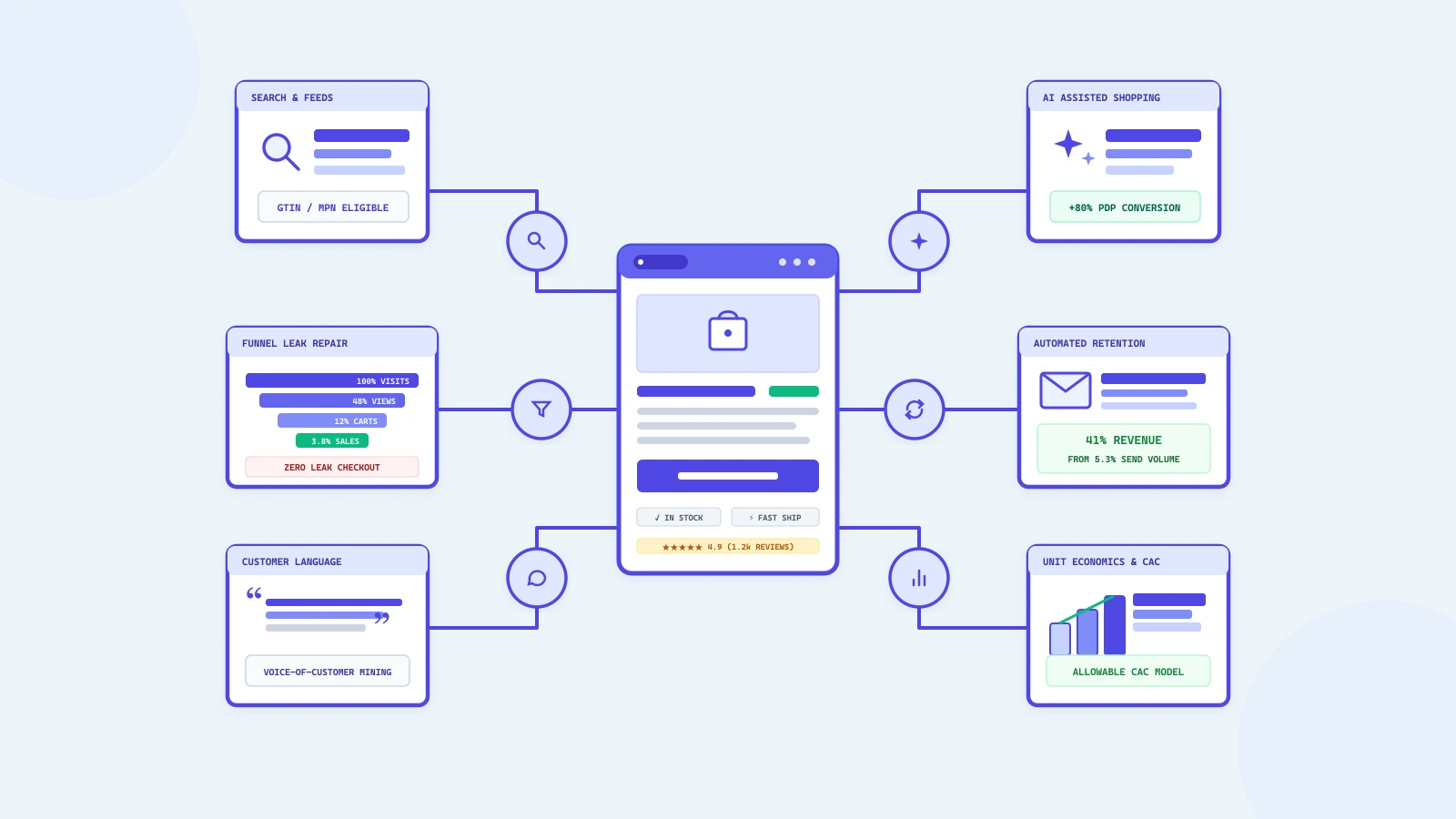
1. The Evidence Framework
Every recommendation in this guide is grounded in four verifiable layers of evidence:
| Evidence Layer | What It Contributes | Limitation |
|---|---|---|
| Official Documentation | Current technical requirements from Google, OpenAI, Microsoft, Shopify, and other platforms | Explains platform behavior, not guaranteed business results |
| Large Behavioral Datasets | Aggregated patterns from billions of sessions, transactions, and messages | Averages may not match your specific category, market, or price point |
| Real-User and UX Research | Observed friction, customer behavior, and tested changes | A case study shows possibility, not a universal lift |
| Merchant Discussions | Language, frustrations, and operational problems that polished reports often miss | Anecdotal and not representative of all stores |
Every benchmark in this guide should be treated as a reference point, not a promise.
2. The Evidence Snapshot: What the Latest Data Says
1. Traffic Became Harder to Earn
Contentsquare's 2026 benchmark covers 99 billion sessions across more than 6,500 websites in nine industries, plus 22 million customer-service interactions. It reports that visits fell 3.8% year over year, engagement fell 10%, and conversion rates fell 5.1%. This is a cross-industry dataset, so it is directional rather than a target for a specific store.
The implication: When traffic is harder to acquire, fixing wasted sessions becomes an essential part of traffic strategy.
2. AI Referrals Are Growing Quickly from a Small Base
In the same Contentsquare dataset, AI referrals represented about 0.2% of traffic. AI-referred traffic grew 632% year over year, and its conversion rate increased 55% to 1.3%. Paid search converted at 2.8%, while organic social was 0.7% in that dataset.
Shopify reported a similar commerce-specific pattern for Q2 2026:
- AI-referred sessions to Shopify storefronts grew 197% year over year, while organic-search sessions grew 12% from a much larger base.
- AI-referred shoppers who reached a product page converted about 80% better than organic-search shoppers.
- Referrals based on structured Shopify Catalog data converted twice as well as referrals based on scraped third-party data.
3. Checkout Remains a Major Leak
Baymard's 2025 update places average cart abandonment at 70.19%, calculated from more than 49 studies. Its product-page research also reports that 64% of users look for shipping-cost estimates before adding an item to the cart, while 43% of sites do not show them on product pages.
4. Conversion Benchmarks Vary Dramatically by Category
Shopify's 2026 conversion guide cites recent industry benchmarks ranging from 0.94% for luxury and jewelry to 6.22% for food and beverage. It lists home and furniture at 1.41%, consumer goods at 2.85%, fashion at 3.06%, pet care at 3.28%, multi-brand retail at 3.93%, and beauty at 4.94%.
5. Automated Retention Outperforms High-Volume Broadcasting
Klaviyo's 2026 email benchmark draws on more than 183,000 customers. Automated flows generated nearly 41% of email revenue from only 5.3% of sends. Flow emails produced a 5.58% average click rate versus 1.69% for campaigns, and a placed-order rate 13 times higher. Nearly 48% of flow-driven revenue came from new buyers, compared with 16% for campaigns.
6. Affiliate Clicks and Order Volume Can Move in Opposite Directions
Impact.com's 2025 benchmark covers 2,368 North American retail brands and nearly one billion transactions. Clicks rose 2% year over year, but transactions declined 5%. Average order value rose 4% (from $118 to $123), while items per order increased from 2.3 to 2.5. Judge partners by new-customer quality, margin, and incrementality, not clicks alone.
7. Faster Experiences Create Measurable Impact
Farfetch combined real-user monitoring, business data, and A/B testing. On its product pages, reducing load time by more than 600 milliseconds produced a 1% to 5% conversion-rate uplift within the company's confidence range. Each additional 100 milliseconds of Largest Contentful Paint (LCP) beyond a threshold resulted in a 1.3% average conversion decline.
3. What Merchants Say When the Dashboard Says “Traffic”
Review of public discussions from r/ecommerce, r/shopify, r/PPC, and Shopify Community reveals six recurring diagnostic problems:
- Pattern 1: Session counts are mistaken for qualified demand. Merchants report hundreds of visitors with zero sales, failing to segment by network, intent, bot traffic, device, or landing relevance.
- Pattern 2: Add-to-cart is a better first diagnostic than revenue. If traffic never adds to cart, changing checkout won't help. If carts are healthy but checkouts collapse, buying more traffic is wasted.
- Pattern 3: Bot and test traffic skew store metrics. Spikes in unengaged visits from unexpected regions often represent automated scrapers or crawlers.
- Pattern 4: Shipping cost is both a forum complaint and a research finding. Shoppers regularly abandon carts to calculate shipping costs when they are hidden on product pages.
- Pattern 5: Measurement systems disagree. Attribution window differences, iOS privacy, and duplicate tags cause GA4, Shopify, and ad platforms to report divergent figures.
- Pattern 6: Community advice always returns to fundamentals. Sustainable growth relies on unique product data, clean technical architecture, and high-utility content.
4. The Qualified Traffic Growth Model
A sustainable ecommerce growth model separates vanity session counts from enterprise value:
Qualified traffic value = Qualified sessions × Conversion rate × Contribution margin per order + Expected repeat contribution
First-Order Contribution Margin Formula:
First-order contribution margin =
Revenue
- cost of goods
- fulfilment
- payment fees
- variable shipping subsidy
- discounts
- returns and refunds
- channel-specific variable costs
Allowable Customer Acquisition Cost (CAC):
Allowable CAC =
First-order contribution margin
+ conservative expected repeat contribution
- required profit per customer
Qualified-Session Rate:
Qualified-session rate =
Sessions from eligible target customers with meaningful engagement
÷ total measured sessions
5. The 13-Step Ecommerce Traffic System
Step 1: Build a traffic truth dashboard
Do this before increasing spend or publishing at scale. Track the full funnel by source and landing page:
| Stage | Minimum Event | What a Large Drop Suggests |
|---|---|---|
| Discovery | Impression or ad view | Eligibility, feed, ranking, audience, or budget problem |
| Visit | Qualified session | Weak title, thumbnail, price, message, or click quality |
| Product Interest | Product view or key interaction | Landing-page mismatch, speed, navigation, or mobile issue |
| Intent | Add-to-cart | Weak offer, proof, information, price, fit, or availability |
| Checkout | Checkout started | Shipping surprise, cart friction, or account requirement |
| Payment | Payment attempted | Payment method, validation, fraud rule, or technical error |
| Purchase | Order completed | Final checkout friction or measurement failure |
| Retention | Repeat order or active subscriber | Product, delivery, support, replenishment, or messaging problem |
Reconcile analytics with orders weekly, use a strict UTM taxonomy, and add a post-purchase 2-question discovery survey (“Where did you first hear about us?” and “What almost stopped you from buying?”).
Step 2: Diagnose the constraint before choosing a tactic
| Symptom | Most Likely Constraint | First Investigation |
|---|---|---|
| Products are not indexed or approved | Eligibility | Search Console, Merchant Center diagnostics, robots, canonicals, feed errors |
| Impressions grow but clicks do not | Click capture | Query relevance, title, image, rating, price, offer, snippet |
| Sessions grow but product views do not | Landing mismatch | Source, landing page, mobile layout, speed, navigation |
| Product views grow but add-to-cart does not | Product or offer | Audience fit, value proposition, proof, price, variants, delivery |
| Add-to-cart is healthy but checkout start is weak | Cart friction | Shipping estimate, taxes, coupon distraction, cart errors |
| Checkout starts but purchases collapse | Checkout friction | Payment methods, validation, forced account, duties, fraud rules |
| Orders grow but profit falls | Economics | Discounts, CAC, returns, fulfilment, marketplace fees |
| First orders grow but repeat purchase does not | Customer quality | Source cohorts, product experience, delivery, retention messaging |
Step 3: Mine real customer language before creating traffic
Build a monthly Voice of Customer (VoC) dataset tagging Problems, Triggers, Alternatives, Objections, Proof Needed, Language, Use Cases, and Failure Modes. Turn observations into multi-surface assets:
$$\text{Customer question} \longrightarrow \text{Product page} \longrightarrow \text{Buying guide} \longrightarrow \text{Merchant Center attribute} \longrightarrow \text{Creator brief} \longrightarrow \text{Email flow}$$
Step 4: Fix conversion leaks before scaling traffic
Ensure product pages answer seven core buyer questions:
- What is it?
- Who is it for?
- What outcome does it create?
- Why should I believe the claim?
- Which variant is right for me?
- What will the total cost and delivery experience be?
- What happens if it does not work for me?
Audit mobile as a buyer and monitor Core Web Vitals (LCP, INP, CLS) from real field data. To systematically diagnose message match, friction points, and conversion bottlenecks across your funnel, follow our How to Turn Clicks Into Clients Guide.
Step 5: Make every product eligible for discovery
Maintain a single product-data source of truth with complete GTIN/MPN identifiers, detailed attributes (color, size, material, gender), and synchronized Merchant Center feeds. Run weekly feed reviews targeting disapprovals, price mismatches, and missing attributes. (You can also run a quick diagnostic on your catalog and sitemaps with our Free Technical SEO Audit Tool or follow our 12-Step Technical SEO Audit Checklist to resolve crawlability issues).
Step 6: Build search demand capture around the catalog
Structure the store logically (Home -> Department -> Category -> Subcategory -> Product). Create indexable category pages with concise definitions, comparison criteria, and buying advice. Preserve value on discontinued products with clear back-in-stock or replacement redirects.
Step 7: Create content with measurable information gain
Score every content piece using the EVIDENCE test (Experience, Verification, Independent value, Decision utility, Evidence diversity, Nuance, Currency, Execution). Produce high-gain assets like documented product tests, calculators, compatibility databases, and customer survey reports.
Step 8: Prepare for AI-assisted shopping without abandoning SEO
AI shoppers submit complex multi-constraint prompts. Provide complete structured attributes, comparison tables, visible factual specifications, and independent review validation. (To configure your store's crawl permissions safely for shopping bots like OAI-SearchBot while protecting proprietary assets, consult our AI Crawler Robots.txt Guide and our foundational How to Do GEO Guide).
Step 9: Use Reddit and forums as a research channel first
Participate ethically in communities. Answer questions fully on-platform, disclose brand affiliation, and link only when the destination provides deeper utility that cannot fit in a reply. Never manufacture fake reviews or astroturf votes.
Step 10: Build a creative demand engine
Combine customer profiles, jobs-to-be-done, objections, proof, and formats into a creative testing matrix. Contract creators for authentic demonstration and evidence rather than borrowed reach alone, and repurpose winning clips across product pages and ads.
Step 11: Scale paid traffic only when unit economics work
Capture high-intent demand via Paid Search & Google Shopping. Use Paid Social to validate demand-creation hypotheses. Enforce strict stop conditions based on CAC thresholds and minimum sample sizes.
Step 12: Turn acquired visitors into an owned audience
Offer high-utility value exchanges (fit selectors, compatibility checklists, restock alerts) instead of aggressive discount popups. Deploy 12 event-driven email flows (Welcome, Browse abandonment, Cart abandonment, Checkout abandonment, Back in stock, Replenishment, Win-back, etc.).
Step 13: Run experiments that create knowledge
Use structured 1-page test cards detailing Observations, Evidence, Hypotheses, Primary/Guardrail metrics, and Decision rules. Prioritize tests by expected profit impact and maintain a centralized learning library.
6. A 90-Day Plan to Improve Ecommerce Traffic
- Days 1 to 15 (Establish Truth): Reconcile orders, net revenue, and analytics. Set up UTM parameters and post-purchase surveys. Calculate contribution margins and verify domain redirects.
- Days 16 to 30 (Repair Largest Leak): Audit mobile purchase paths, surface delivery/return details on product pages, fix high-impact Core Web Vitals issues, and run initial A/B test.
- Days 31 to 45 (Expand Eligibility): Resolve Merchant Center disapprovals, align structured data with page content, and enhance top category pages.
- Days 46 to 60 (Build Information Gain): Mine customer support logs, build an original calculator or comparison database, and distribute to relevant publishers.
- Days 61 to 75 (Add One Demand Engine): Scale one proven acquisition channel (Paid Search, YouTube, Creators, or Digital PR) with strict stop conditions.
- Days 76 to 90 (Retain and Scale): Optimize automated email flows, evaluate 60-day customer cohorts, eliminate unprofitable traffic, and build the next quarter's roadmap.
7. Channel Selection by Product Reality
| Product Reality | First Capture Channel | First Creation Channel | First Retention System |
|---|---|---|---|
| Existing search demand | SEO, Merchant Center, paid search | Comparison content or YouTube | Email flows |
| Product needs demonstration | Shopping and branded search | Creators, video, paid social | Email plus retargeting |
| High trust requirement | Search and comparison publishers | Expert content, communities, credible creators | Educational nurture |
| Visual and aspirational | Image search, Pinterest, marketplaces | Short video and creators | Email, loyalty, referral |
| High repeat purchase | Search or sampling | Creator education | Replenishment, subscription, loyalty |
| Low budget | Technical SEO and free listings | One repeatable organic format | Email capture and flows |
| Complex specifications | SEO, paid search, AI discovery | Detailed comparisons and tools | Saved lists, alerts, nurture |
8. 12 Practices to Stop Doing Immediately
- Buying low-intent traffic to make session graphs rise.
- Publishing generic articles without product or customer evidence.
- Sending every campaign to the homepage.
- Hiding shipping cost until checkout.
- Using platform ROAS as the only source of truth.
- Treating a few Reddit comments as a statistical study.
- Opening a new channel without an owner and production system.
- Using follower count as the main creator criterion.
- Allowing product feeds and landing pages to disagree.
- Measuring email mainly by opens.
- Redirecting discontinued products and old articles to the homepage.
- Changing domain, URL structure, CMS, design, and content simultaneously when it can be avoided.
9. Domain Migration Checklist for This Guide
- Publish the finished guide on
imvasa.devat/guides/12-proven-traffic-sources-for-ecommerce-in-2026-complete-growth-guide. - Redirect the old article directly:
https://www.imvasa.xyz/blog/12-proven-traffic-sources-for-ecommerce-in-2026-complete-growth-guide$\longrightarrow$https://imvasa.dev/guides/12-proven-traffic-sources-for-ecommerce-in-2026-complete-growth-guide - Use a server-side 301 or 308 redirect.
- Avoid redirect chains and loops.
- Add a self-referencing canonical to the new URL.
- Update internal links, navigation, feeds, hreflang, and structured data to the new domain.
- Verify both domain properties in Google Search Console.
- Submit Change of Address after redirects are active.
- Submit the new XML sitemap.
- Keep the old domain and redirects active for at least one year, preferably indefinitely.
- Monitor old and new URLs for impressions, canonical selection, 404s, and server errors.
10. Frequently Asked Questions
How do I increase ecommerce traffic quickly?
Fix eligibility and activate sources with existing intent first. Merchant Center free listings, paid search, Shopping, marketplaces, affiliates, and existing email subscribers produce feedback faster than a new SEO program. Speed does not remove the need for tracking, strong landing pages, and profitable unit economics.
What should I fix if I have traffic but no sales?
Inspect the funnel in order. Confirm that visits are real and relevant, then compare product views, add-to-cart, checkout starts, payment attempts, and purchases. No add-to-cart points toward traffic quality, page relevance, offer, proof, price, fit, or product information. Checkout abandonment points more toward shipping, payment, account, trust, or technical friction.
How much traffic do I need before judging conversion?
There is no universal session number. The required sample depends on expected conversion rate, the size of the change you need to detect, seasonality, and traffic mix. Avoid strong conclusions from a few hundred mixed sessions. Segment first, choose a primary event, and use a sample-size calculator or statistical test for controlled experiments.
Is SEO still worth it for ecommerce in 2026?
Yes, especially for categories, products, comparisons, compatibility, and recurring buyer questions. Organic search remains much larger than AI referral traffic. Strong SEO also supports AI visibility because crawlability, indexation, internal links, visible text, product data, and useful content remain foundational.
How can I get ecommerce traffic from AI assistants?
Maintain crawlable product pages, accurate structured data, current feeds where supported, stable product identifiers, clear specifications, shipping and returns, strong images, useful comparisons, and independent evidence. Measure AI referrals, but do not replace proven channels based only on high year-over-year growth from a small base.
Is Reddit a good traffic source for ecommerce?
It can be, but its highest value is often research and trust rather than direct last-click traffic. Participate transparently, answer questions fully, disclose affiliation, and link only when helpful. Never manufacture recommendations or disguise promotion as a customer opinion.
Should I focus on traffic or conversion first?
Fix severe conversion and technical problems before scaling. A store still needs enough qualified traffic to learn, so the process is iterative. Acquire a controlled amount of relevant traffic, observe the funnel, repair the largest leak, then increase volume.
What are the best ecommerce traffic channels?
The best channel matches the customer's buying behavior. Use search and Shopping when demand already exists, creators and video when the product needs demonstration, comparison content and communities when trust is the barrier, and email or replenishment when repeat purchase is central.
11. Research Sources
Official Platform Documentation and Blogs
- Google Search Central, Site moves and URL changes: https://developers.google.com/search/docs/crawling-indexing/site-move-with-url-changes
- Google Search Central, Product structured data: https://developers.google.com/search/docs/appearance/structured-data/product
- Google Search Central, Merchant listing structured data: https://developers.google.com/search/docs/appearance/structured-data/merchant-listing
- Google Search Central, AI features and your website: https://developers.google.com/search/docs/appearance/ai-features
- Google Merchant Center product-data specification: https://support.google.com/merchants/answer/7052112
- Google Merchant Center free listings: https://support.google.com/merchants/answer/9199328
- OpenAI, Product feeds for commerce: https://developers.openai.com/commerce/specs
- OpenAI Help, Shopping with ChatGPT Search: https://help.openai.com/en/articles/11128490-shopping-with-chatgpt-search
- Microsoft Advertising, Agentic Commerce: https://about.ads.microsoft.com/en/solutions/technology/agentic-commerce
- Shopify, AI and organic search category behavior: https://www.shopify.com/enterprise/blog/ai-search-category-behavior
- Shopify, Ecommerce conversion rate: https://www.shopify.com/blog/ecommerce-conversion-rate
- Shopify, Traffic but no sales: https://www.shopify.com/blog/traffic-no-sales
Large Datasets, UX Research, and Real-User Evidence
- Contentsquare, 2026 Digital Experience Benchmark: https://contentsquare.com/guides/digital-experience-benchmark
- Contentsquare, 2026 conversion and AI traffic analysis: https://contentsquare.com/guides/digital-experience-benchmark/conversions
- Baymard Institute, 2025 cart-abandonment research: https://baymard.com/blog/ecommerce-checkout-usability-report-and-benchmark
- Klaviyo, 2026 email benchmarks from 183,000+ customers: https://www.klaviyo.com/products/email-marketing/benchmarks
- impact.com, 2025 affiliate benchmark: https://impact.com/affiliate/affiliate-marketing-benchmark/
- web.dev, Farfetch real-user performance case study: https://web.dev/case-studies/farfetch
- Adobe Digital Insights, ecommerce and AI shopping research: https://business.adobe.com/blog/generative-ai-powered-shopping-rises-with-traffic-to-retail-sites
Public Reddit and Merchant-Forum Discussions Reviewed
These links are qualitative field notes, not benchmark studies.
- r/ecommerce, Traffic no sales: https://www.reddit.com/r/ecommerce/comments/1om5sp2/traffic_no_sales/
- r/ecommerce, Traffic but almost no sales: https://www.reddit.com/r/ecommerce/comments/1nxq3hx/getting_traffic_but_almost_no_sales_i_cant_figure/
- r/ecommerce, 500 visitors and no sales: https://www.reddit.com/r/ecommerce/comments/1i66y92/500_visitors_no_saleswhat_am_i_doing_wrong_with/
- r/shopify, Cart abandonment and shipping discussion: https://www.reddit.com/r/shopify/comments/1k96mol/cart_abandonment_im_getting_fed_up/
- r/PPC, Google Ads, Analytics, and Shopify conversion discrepancy: https://www.reddit.com/r/PPC/comments/sgf892/google_ads_shopify_store_ga_shows_3x_conversion/
- Shopify Community, Heavy traffic but no sales: https://community.shopify.com/t/heavy-traffic-but-no-sales/561133
- Shopify Community, Visits but no conversions or add-to-cart: https://community.shopify.com/t/lots-of-visit-but-no-conversions-or-add-to-cart/261793
- Shopify Community, Improving SEO and organic traffic: https://community.shopify.com/t/how-can-i-improve-my-shopify-store-s-seo-performance-and-increase-organic-traffic/579365
Editorial and Methodology Notes
This version changes the article from a list of traffic sources into a constraint-led guide for improving qualified ecommerce traffic. Statistics are labeled by evidence type and date. Vendor and platform data are presented as directional evidence, not universal guarantees. Public forum discussions are treated as qualitative observations rather than a representative sample. The original contribution includes the Qualified Traffic Growth Model, the funnel constraint diagnostic, the customer-language workflow, the EVIDENCE content test, experiment cards, and a migration-safe 90-day implementation plan.
// RECOMMENDED READING & COMPANION GUIDES
How to Turn Clicks Into Clients: 2026 Guide
Fix message match, friction points, discovery funnels, and response time to turn search clicks into revenue.
OAI-SearchBot and AI crawler robots.txt guide
What OAI-SearchBot is, how it differs from GPTBot, and copy-paste robots.txt rules for ChatGPT, Claude, Perplexity and Google-Extended.
Identify the Exact Constraint in Your Traffic & Funnel
I perform deep diagnostic audits across technical SEO, structured product feeds, AI shopping search, and funnel leak points to uncover where revenue is being lost.