
How to Turn Clicks Into Clients: 2026 Conversion Guide
Learn how to turn website clicks into paying clients. Fix message match, proof, offers, forms, response time, discovery calls, and follow-up with real data.
- ✓The 6-Gate Click-to-Client Ledger (Arrival, Belief, Ask, Contact, Consult, Close)
- ✓Evidence-Backed Speed-to-Lead SLAs & First Response Architecture
- ✓The SCOPE Discovery Framework & Internal Champion Proposal Kits
- ✓30-Day Implementation Plan & 14 High-Impact Fixes Ranked by Effort
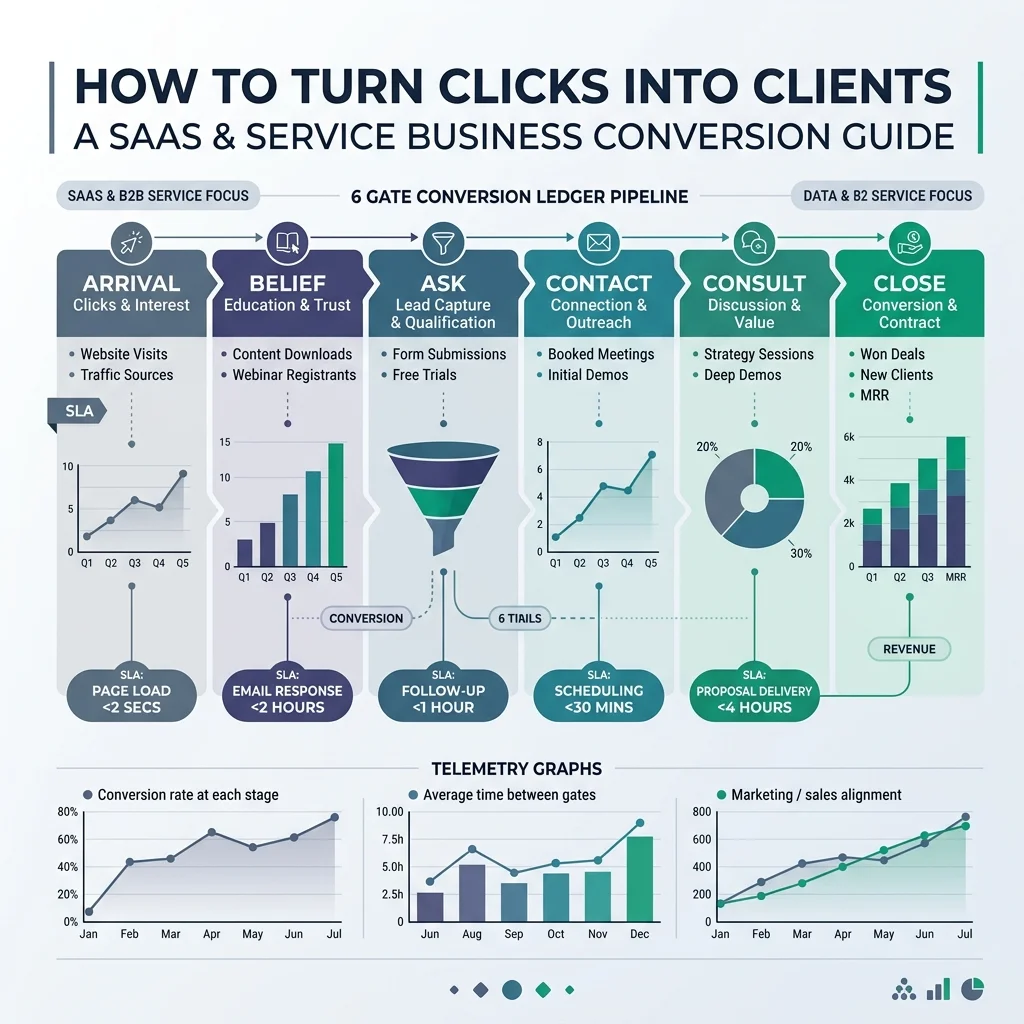
Quick answer: To turn clicks into clients, match the page to the searcher's intent, prove you can solve the problem with specific evidence, offer a next step that feels safe, respond within minutes, qualify the fit honestly, and follow up until you get a decision. Most businesses do not have a traffic problem. They have a leak between the click and the signed agreement, and every leak is measurable.
How to turn clicks into clients in 9 steps
- Define what a client is worth and which clicks can realistically become one.
- Measure the full path from click to signed client, gate by gate, so you know where the loss happens.
- Fix message match so the page answers the exact problem behind the search.
- Replace claims with proof a stranger can verify in under 30 seconds.
- Offer a next step that matches how ready the visitor actually is.
- Remove friction from the request itself, especially on mobile.
- Respond fast, ideally within five minutes, with a human and a specific reply.
- Run a qualification and discovery process that earns the right to propose.
- Follow up, enable the internal decision, and measure clients, not form fills.
That sequence matters. Speed cannot rescue a page that attracted the wrong visitor. A beautiful page cannot rescue a five-day response time. A great call cannot rescue a proposal that never gets a decision.
Why clicks do not become clients
Most teams look for one broken thing. In practice, a client acquisition path is a chain of small conversions, and a chain fails at whichever link is weakest.
Here is the diagnostic that separates the six most common failure patterns:
| Symptom | Most likely cause | First thing to inspect |
|---|---|---|
| Traffic rises, inquiries stay flat | Wrong intent or wrong keyword mix | Landing queries, page purpose, buyer readiness |
| Visitors read a lot but never contact | Missing proof or unclear next step | Case evidence, pricing clarity, call to action design |
| Form starts but few completions | Friction, trust, or wrong ask | Field count, field type, mobile behavior, error handling |
| Inquiries arrive but never reply again | Slow or generic first response | Response time, channel, personalization, routing |
| Calls happen but proposals stall | Weak qualification or unclear economics | Discovery questions, decision process, budget reality |
| Proposals sent but no decision | No internal champion enablement | Stakeholder map, risk reversal, decision timeline |
Each row is a different business problem with a different fix. That is why a single conversion rate number is almost useless for diagnosis.
The Five Yeses a client says before paying you
Before anyone becomes a client, they say yes five times. The words are never spoken, but every yes is a decision point you can design.
- Yes, this is about my problem. The page reflects their situation, not your service catalog.
- Yes, these people can actually do it. Evidence, specificity, and relevant experience.
- Yes, the next step is safe. Low perceived risk, clear expectations, no ambush selling.
- Yes, they behave like professionals. Fast, competent, specific first contact.
- Yes, this is worth the money and the internal effort. Scope, price, risk, and approval path.
Miss the first yes and nothing else runs. Win the first four and lose the fifth, and you become the vendor who almost won.
The Click-to-Client Ledger
Stop measuring one conversion rate. Measure six gates, then attack the gate that loses the most future clients.
| Gate | What it measures | Practical metric | Typical service business range |
|---|---|---|---|
| G1 Arrival | Did the right person land on the right page | Qualified visit share, scroll and engaged reads | Highly variable by channel |
| G2 Belief | Did they accept you as credible | Proof page views, return visits, brand searches | 10 to 40 percent of engaged visitors |
| G3 Ask | Did they request something | Inquiry rate on the money pages | 2 to 10 percent |
| G4 Contact | Did you actually reach them | Contact rate on new inquiries | 40 to 80 percent |
| G5 Consult | Did the meeting happen | Booked-to-held rate | 55 to 85 percent |
| G6 Close | Did they sign | Proposal-to-client rate | 20 to 50 percent |
Those ranges are planning anchors, not targets. Your own trailing 90-day numbers are the only honest benchmark, because price point, urgency, market, and channel change everything.
The leak math that tells you what to fix first
Work in absolute clients, not percentages. Take a monthly example for a service business with a 6,000 dollar average engagement:
4,000 clicks on service and guide pages
  x 5% inquiry rate            = 200 inquiries
  x 60% contact rate           = 120 conversations
  x 70% consult held rate      =  84 consults
  x 45% proposal rate          =  38 proposals
  x 35% close rate             =  13 clients
  x $6,000 average engagement  = $78,000 booked
Now test single-gate improvements, holding everything else constant:
| Improvement | New client count | Monthly revenue change |
|---|---|---|
| Inquiry rate 5 to 6 percent | 15.9 | plus about 17,400 dollars |
| Contact rate 60 to 80 percent | 17.6 | plus about 27,700 dollars |
| Consult held 70 to 85 percent | 16.0 | plus about 18,000 dollars |
| Close rate 35 to 42 percent | 15.9 | plus about 17,400 dollars |
| Traffic plus 25 percent, nothing else | 16.5 | plus about 20,900 dollars |
Two lessons appear immediately. First, the contact-rate fix beats a 25 percent traffic increase and usually costs nothing but a process change. Second, gates multiply, so two modest fixes in sequence outperform one heroic fix.
Bottleneck rule: rank fixes by clients gained per unit of effort, not by how broken something feels.
Build your own ledger in one hour
Create a simple sheet with one row per month and these columns:
Month | Money-page sessions | Inquiries | Contacted | Consults held |
Proposals | Clients | Revenue | Avg engagement value | Source
Rules that keep the ledger honest:
- Count inquiries at the point of human-reviewable intent, not newsletter signups.
- Count a consult only when it actually happened.
- Attribute by first meaningful source and keep the raw source in a second column.
- Track by cohort month of inquiry, not month of closing, or long sales cycles will lie to you.
- Record disqualified inquiries separately. A falling close rate caused by more junk leads is a lead-quality problem, not a sales problem.
What the evidence says about how people actually buy now
Four findings should shape every decision in this guide.
1. Buyers arrive late, already leaning toward someone. 6sense's Buyer Experience research reports that buyers are roughly 70 percent through their buying process before contacting sellers, initiate that first contact most of the time, and usually already have a preferred vendor and largely formed requirements when they do (https://6sense.com/science-of-b2b/buyer-experience-report-2025/). The implication is blunt: your website is doing the selling long before any conversation, and the first conversation is often a confirmation, not an introduction.
2. Buyers want to self-serve, but self-serve alone produces worse decisions. Gartner's B2B buying research has consistently found buyers spend only a small share of the journey with any supplier, prefer rep-free experiences, and yet are meaningfully more likely to complete a high-quality deal when they combine supplier digital tools with human help, while purely self-service digital purchases carry higher purchase regret (https://www.gartner.com/en/sales/insights/b2b-buying-journey). Gartner's 2026 sales survey put the rep-free preference at 67 percent of buyers, with 45 percent reporting AI use during a recent purchase. Design for independent research and easy human access at the same time.
3. The decision is a committee sport, and validation beats persuasion. Forrester's State of Business Buying, 2026 reports the typical buying decision now involves 13 internal stakeholders and nine external influencers, that generative AI is often the starting point but delivers incomplete or unreliable information which pushes buyers toward trusted human validation, that procurement is a decision-maker in 53 percent of cycles, and that more than 60 percent of buyers use some form of trial to reduce risk (https://www.forrester.com/press-newsroom/forrester-2026-the-state-of-business-buying/). Your job is to arm one internal champion with material that survives a room you will never enter.
4. In local and consumer-facing services, reviews are the gate. BrightLocal's Local Consumer Review Survey 2026 found 97 percent of consumers read reviews for local businesses, 47 percent will not use a business with fewer than 20 reviews, 74 percent care only about reviews from the last three months, 31 percent now require 4.5 stars or better, 80 percent are more likely to use a business that responds to every review, and 89 percent expect owners to respond at all. AI tools jumped from 6 percent to 45 percent as a source of local recommendations, and 82 percent read AI-generated review summaries (https://www.brightlocal.com/research/local-consumer-review-survey/).
Read those four together and the modern path is clear. Independent research, then peer and review validation, then a short human interaction that must not feel like a sales trap.
Realistic conversion benchmarks, and how to use them safely
Unbounce's Conversion Benchmark Report, built on tens of millions of conversions, puts median landing page conversion around the mid single digits with wide category variation, including roughly 3.8 percent for SaaS and about 6.2 percent for commercial and professional services (https://unbounce.com/conversion-benchmark-report/).
Use benchmarks for three purposes only:
- Sanity checking whether a number is plausible.
- Deciding whether a problem is likely page-level or process-level.
- Setting a floor below which you should investigate rather than optimize.
Never use them as targets. A 2 percent inquiry rate on high-intent commercial pages with a 40,000 dollar average engagement can be a better business than a 14 percent rate on a free-checklist page.
Gate 1: Make the arrival match the intent
The fastest conversion win in most businesses is not a new button color. It is sending each query to a page that was built for that query.
The message match test
Open the page and answer these in the first screen, without scrolling:
- What exactly is offered?
- Who is it for, stated specifically?
- What problem does it solve, in the visitor's own words?
- Why you and not the obvious alternative?
- What happens next, and what does it cost in time or money?
If a stranger cannot answer all five in about eight seconds, the page is leaking before anything else can matter. For aligning search queries with format-level intent on Google Search before visitors land, follow our How to Rank #1 on Google Playbook.
Map pages to buyer readiness
| Visitor state | Query pattern | Right page | Right next step |
|---|---|---|---|
| Problem aware | "why is X happening" | Guide or diagnostic article | Self-check tool, checklist, newsletter |
| Solution aware | "how to fix X" | Method or service explainer | Free teardown, sample, calculator |
| Vendor comparing | "best X service", "X vs Y" | Comparison or alternatives page | Pricing view, short fit call |
| Ready to hire | "X consultant near me", "hire X" | Service or location page | Booking, phone, quote request |
| Validating you | your brand plus "reviews", "pricing" | Proof, pricing, about | Direct booking, references |
The most common structural mistake is pointing every page at one generic contact form. The second most common is asking ready-to-hire visitors to download a PDF instead of booking.
Anatomy of a service page that converts
Order matters, because attention decays.
1. Outcome headline naming the audience and the result
2. One-sentence plain description of what you do
3. Primary call to action, visible without scrolling
4. Three to five proof points with numbers or named clients
5. The problem stated better than the visitor could state it
6. Your approach in three to five concrete steps
7. What is included, what is not, and typical timeline
8. Price, price range, or a clear explanation of how price is set
9. Two or three specific case examples with before and after
10. Objection handling section written as real questions
11. Reviews or testimonials that mention outcomes and process
12. Who this is not right for, stated honestly
13. Repeat call to action with alternative low-commitment option
Two details do disproportionate work. Naming who it is not for raises trust and improves lead quality at the same time. Placing a second call to action at the natural point of decision, right after case examples, captures people who were not ready at the top.
Speed and mobile are conversion features
Slow pages lose people before any argument lands. Check the real mobile experience on a mid-range phone and a normal connection, not a desktop simulation. Watch for layout shifts that move the button, tap targets too close together, sticky bars that cover form fields, and consent banners that block the primary action.
Gate 2: Replace claims with verifiable proof
Trust is the actual product on a service website. Nielsen Norman Group's ecommerce trust and credibility research makes the point plainly: trust determines whether a user will risk time, money, and personal data, and losing it loses the sale (https://www.nngroup.com/reports/ecommerce-ux-trust-and-credibility/).
The proof stack, ranked by persuasive weight
| Rank | Proof type | Why it works | Weak version to avoid |
|---|---|---|---|
| 1 | Specific outcome with a named client and timeframe | Verifiable and comparable | "We drive growth" |
| 2 | Third-party reviews with recent dates | Independent and hard to fake | Undated five-star wall |
| 3 | Work samples and teardowns | Demonstrates skill directly | Logo grid with no context |
| 4 | Process transparency and artifacts | Reduces fear of the unknown | Vague "proven process" |
| 5 | Relevant credentials and certifications | Category-specific credibility | Irrelevant awards |
| 6 | Risk reversal, guarantees, pilots | Shifts risk off the buyer | Guarantee with hidden terms |
| 7 | Volume claims and years in business | Baseline reassurance only | "Trusted by thousands" |
The specificity test
Every proof element must pass three checks:
- Named or dated: who, when, or which market.
- Numerical or observable: a figure, a screenshot, an artifact, or a quote about a real event.
- Relevant: the reader can see themselves in it.
A testimonial that says "great to work with" fails all three. A testimonial that says "they rebuilt our intake process in six weeks and our response time went from two days to under an hour" passes all three.
The case study format that closes deals
For a concrete example of this exact format in action, see how we documented KSV Engineering's B2B international search growth. (To eliminate trust leaks and score your landing pages against Google rater standards, read our E-E-A-T Trust Engineering Guide).
Keep it to one screen and follow this order:
Client and context in one line, with size and industry
The problem, with the cost of the problem
What you did, in three to five steps
What happened, with before and after numbers
How long it took and what it cost, or the range
One client quote about working with you
Who this result is repeatable for, and who it is not
The last line is the differentiator. It signals judgment rather than salesmanship, and it pre-qualifies the reader.
Reviews are a system, not a task
Given that recency and response behavior now drive local trust, run reviews on a schedule:
- Ask at the moment of delivered value, not at invoice time.
- Ask one specific question so the review contains useful detail.
- Make asking part of project close-out, with an owner and a target count per month.
- Respond to every review, specifically, without templates.
- Keep a rolling three-month freshness goal rather than a lifetime total.
- Route negative feedback into a fix log, then reply describing the fix.
Proof for the AI research layer
Buyers now begin in answer engines and AI summaries, then verify with humans. To be usable at that stage, make your evidence extractable:
- State outcomes as plain sentences near a relevant heading, not only inside images or slides.
- Keep pricing, service areas, timelines, and inclusions in text.
- Use consistent business name, service names, and location details everywhere.
- Publish comparison and alternatives content honestly, including where you are not the best fit.
- Keep dates visible so freshness is verifiable.
Gate 3: Design the ask around readiness, not hope
One generic "Contact us" is a bet that every visitor is equally ready. They are not.
The next-step ladder
| Readiness | Offer | Commitment | What it must promise |
|---|---|---|---|
| Just researching | Guide, checklist, calculator, benchmark tool | Under a minute | Immediate usefulness, no call |
| Comparing approaches | Teardown, sample audit, template, recorded walkthrough | Two to five minutes | Specific insight about them |
| Evaluating vendors | Short fit call, pricing conversation, references | 15 to 20 minutes | Clear agenda and no hard sell |
| Ready to start | Booking, quote request, paid diagnostic, pilot | Real money or calendar time | Fast scheduling and clarity |
| Blocked internally | Business case pack, security or compliance pack, ROI model | Async | Material that survives a committee |
Run at least two live offers per money page: one immediate self-serve step and one human step. Forrester's finding that trials and validation reduce perceived risk applies to services too. A paid diagnostic, a fixed-scope pilot, or a first-milestone-only agreement is the service equivalent of a trial.
Call to action copy that outperforms
Weak calls to action describe your process. Strong ones describe the visitor's outcome and the cost of the step.
| Replace | With | Why |
|---|---|---|
| Submit | Get my project estimate | Names the reward |
| Contact us | Book a 15-minute fit call | Sets duration and format |
| Learn more | See pricing and timelines | Removes ambiguity |
| Request a demo | Watch a 4-minute walkthrough now | Removes the meeting barrier |
| Get started | Start with a paid 2-week diagnostic | Sets scope and risk |
Add a single line of microcopy under the button that answers the unasked question: what happens next, who replies, and how fast.
Pricing information is a conversion tool
If you publish nothing about price, you filter out serious buyers and attract people who cannot afford you. If exact pricing is impossible, publish structure instead:
- Typical engagement ranges by scope tier.
- What drives price up or down.
- Minimum engagement size.
- What is included at each tier.
- Payment structure and timeline.
This converts twice. It removes an objection, and it disqualifies mismatches before they consume your calendar.
Gate 4: Remove friction from the request
The truth about form length
The popular rule is that shorter forms always convert better. The evidence is more nuanced. HubSpot's analysis of more than 40,000 landing pages found conversion declines only slightly as the number of fields increases, while certain field types, especially multiple free-text areas, depress conversion sharply (https://blog.hubspot.com/blog/tabid/6307/bid/6746/which-types-of-form-fields-lower-landing-page-conversions.aspx).
Baymard Institute's checkout and form usability research points the same direction: perceived effort, unclear requirements, and validation problems drive abandonment, and many sites fail basics such as explicitly marking which fields are required and which are optional (https://baymard.com/research/checkout-usability).
So the working rule is not "fewer fields." It is:
Ask only what you need to give a useful first response, make every field feel effortless, and never surprise the user with an error.
Form field decision rules
- Every field must have a job in your first reply. If it does not change what you say or who handles it, delete it.
- Prefer choices over typing. Buttons and selects beat open text on mobile.
- Use one free-text field maximum, and make it optional with a helpful prompt.
- Mark required and optional fields explicitly.
- Validate inline, describe the fix, and never clear the form on error.
- Use correct mobile input types for phone, email, and numbers.
- Keep one column, large tap targets, and a visible button without scrolling on phones.
- Show what happens next directly above the button.
- If the form is long by necessity, split it into steps with progress shown and the easiest question first.
- Test the form monthly on a real phone, and confirm submissions actually arrive.
The silent killer: forms that break or never deliver
Before optimizing anything, verify delivery. Submit a real test inquiry through every form, on mobile and desktop, from an outside network. Confirm it arrives in the inbox and the CRM, that autoresponders fire, that notifications reach a human who is awake, and that spam filtering is not eating them. Broken plumbing explains a surprising share of "our website does not generate leads."
Offer channels people actually use
Different buyers convert on different channels. Provide, and staff, at least three:
- Direct booking on a calendar, with buffer and timezone handling.
- Phone, with real answering during stated hours.
- Text or WhatsApp for local and field services.
- Email or form for async and procurement-driven buyers.
- Chat, only if a human or a well-scoped assistant answers quickly.
A chat widget that promises instant help and delivers nothing is worse than no chat.
Gate 5: Respond like the decision is being made right now
This is the cheapest and most ignored lever in client acquisition.
What the response-time research actually says
Harvard Business Review's audit of 2,241 US companies found an average first response time of about 42 hours, with a large share never responding at all, and reported that firms contacting a lead within an hour were far more likely to qualify it than those waiting longer (https://hbr.org/2011/03/the-short-life-of-online-sales-leads).
The widely cited Lead Response Management study found that contacting a web lead within five minutes rather than 30 minutes produced dramatically higher odds of making contact and of qualifying the lead.
One important caveat that most articles get wrong: those studies measured contact and qualification rates, not final close rates. Speed does not make a bad-fit lead good. It wins the conversation that a slower competitor loses. Treat speed as an advantage in reaching people, then let qualification do its job.
The response service level agreement
Write this down and hold the team to it:
High-intent inquiry (quote, booking, pricing, demo)
  First reply: under 5 minutes during business hours, under 30 minutes otherwise
  Channel: same channel plus one alternate
  Owner: named person, with a named backup

Medium-intent inquiry (question, guide download with buying signal)
  First reply: under 1 hour during business hours

After-hours
  Immediate automated acknowledgement with a real time commitment
  Human reply first thing next business morning

Persistence
  6 to 8 attempts across 14 days, mixing channels, then a clear close-out message
What the first reply must contain
An instant generic autoresponder is not a response. A strong first reply is short and does four things:
- Confirms you understood the specific request, quoting their own words.
- Gives one piece of value immediately, such as an observation, range, or relevant example.
- Proposes one concrete next step with two time options.
- Sets expectations about what happens if they do not reply.
Example structure you can adapt:
Subject: {Their problem in their words}

Hi {Name}, thanks for reaching out about {specific request}.

Quick thought before we talk: {one specific observation about their site,
situation, or numbers, showing you actually looked}.

Projects like this usually land between {range} and take {timeline},
depending on {the two real variables}.

Are you free {option 1} or {option 2} for 15 minutes? If neither works,
reply with a time and I will make it work.

If now is not the right moment, tell me and I will follow up in {timeframe}
rather than chasing you.
That last line raises reply rates because it removes the fear of being pursued.
Reduce no-shows
Booked calls that do not happen are pure waste. Cut them with:
- Confirmation immediately, plus reminders 24 hours and one hour before.
- A one-line agenda and expected duration in the invite.
- A single question to answer before the call, which also confirms intent.
- Easy rescheduling, because a reschedule is far better than a no-show.
- Calling once at the scheduled time before marking a no-show.
- One recovery message the same day, and one a week later.
Gate 6: Qualify, diagnose, and propose
More inquiries do not help if your calendar fills with people who cannot buy. Qualification protects both sides.
The SCOPE qualification test
Run this in the first 10 minutes of any conversation:
| Letter | Question it answers | Ask it like this |
|---|---|---|
| S, Situation | What is actually happening now | "Walk me through how this works today." |
| C, Consequence | What does the problem cost | "What does this cost you monthly if nothing changes?" |
| O, Owner | Who decides and who signs | "Who else needs to be comfortable with this?" |
| P, Priority | Where does it rank right now | "What happens to this if your quarter gets busy?" |
| E, Economics | Is there real budget and value | "What range were you expecting, so I can be honest quickly?" |
If Consequence and Priority are weak, the deal will stall no matter how good your proposal is. Say so early and offer a lighter first step instead.
The discovery call that earns a proposal
A 30-minute structure that consistently works:
0 to 2 min    Agenda, timing, and permission to ask direct questions
2 to 12 min   Their situation, in their words, with cost of the problem
12 to 18 min  Constraints: decision process, timeline, budget reality
18 to 24 min  Your view: what you would do, what you would not, and why
24 to 28 min  Fit check, including honest disqualification if needed
28 to 30 min  Exact next step, owner, and date
Rules that raise close rates:
- Do not present slides until you have heard the problem.
- Give one genuinely useful recommendation on the call, even if they never hire you.
- Name a risk in your own approach. Credibility comes from balance.
- Say the price range out loud on the call. Do not let the proposal be the first mention.
- Never end without a scheduled next action.
Proposals that get decisions
With 13 internal stakeholders and nine external influencers in a typical decision, your proposal is not read by one person in one sitting. Build it to travel.
1. One-page summary a busy executive can read in 60 seconds
2. The problem in their words, with the cost of inaction
3. Recommended option, plus one smaller and one larger option
4. Scope: exactly what is included and excluded
5. Timeline with milestones and dependencies on them
6. Price, payment schedule, and what changes the price
7. Evidence: one closely comparable case with numbers
8. Risk reversal: pilot, milestone exit, or guarantee terms
9. Answers to procurement, security, legal, and compliance questions
10. Decision path: who signs, what is needed, and by when
Add an internal-champion kit: a short summary they can forward, three bullet points that answer "why now," and a page that answers the objection you know their finance team will raise.
Follow up without becoming noise
A useful cadence after a proposal:
Day 0    Send, with a 60-second summary in the message body
Day 2    One useful addition: a relevant example or a specific answer
Day 5    Offer a 10-minute call to walk their team through it
Day 9    Address the most likely internal objection directly
Day 14   Offer a smaller starting scope
Day 21   Clear close-out: ask whether to close the file or follow up later
Day 60   Value-only check-in with something genuinely new
Every message should carry information, not pressure. The close-out message frequently revives deals, because it gives the buyer permission to be honest.
The 14 highest-impact fixes, ranked by effort
| Rank | Fix | Effort | Typical gate improved |
|---|---|---|---|
| 1 | Verify every form, call, and chat actually delivers to a human | Very low | G3 and G4 |
| 2 | Set and enforce a 5-minute response rule during business hours | Low | G4 |
| 3 | Add a booking link with real availability everywhere you ask for contact | Low | G3 and G5 |
| 4 | Publish price ranges or pricing logic | Low | G2 and G3 |
| 5 | Rewrite the primary call to action to name the outcome and duration | Low | G3 |
| 6 | Add three specific, numeric proof points above the fold | Low | G2 |
| 7 | Cut or convert free-text form fields to choices | Low | G3 |
| 8 | Add reminder and no-show recovery sequences | Low | G5 |
| 9 | Add a "who this is not for" section | Low | G2 and G6 |
| 10 | Build one comparison or alternatives page | Medium | G1 and G2 |
| 11 | Run a monthly review request and response routine | Medium | G2 |
| 12 | Create a low-risk paid first step, pilot, or diagnostic | Medium | G6 |
| 13 | Build the internal champion kit for proposals | Medium | G6 |
| 14 | Instrument the full ledger from click to signed client | Medium | All |
Start at the top. The first nine items usually take less than two weeks combined and often move more revenue than a redesign.
Measure clients, not form fills
Most conversion reporting stops at the lead. That is why teams optimize toward cheap leads that never become clients.
The metrics that matter
| Metric | Definition | Why it matters |
|---|---|---|
| Cost per qualified inquiry | Spend divided by inquiries that pass qualification | Filters out junk volume |
| Contact rate | Reached divided by inquiries | Exposes response process failures |
| Consult held rate | Held divided by booked | Exposes scheduling and intent problems |
| Proposal rate | Proposals divided by consults held | Exposes qualification quality |
| Win rate | Clients divided by proposals | Exposes offer, price, and trust issues |
| Cost per client | Total spend divided by clients | The only number that pays salaries |
| Average engagement value | Revenue divided by clients | Reveals mix and pricing shifts |
| Time to first response | Median minutes to human reply | The most controllable lever |
| Time to close | Median days from inquiry to signed | Drives forecasting and cash flow |
| Client quality score | Margin, fit, retention, referral potential | Prevents winning bad business |
Track lead source end to end
Do three things and most attribution arguments disappear:
- Capture the original source, campaign, landing page, and first query where available, and store them on the contact record in your CRM.
- Ask a single self-reported question on the form: "How did you hear about us?" It captures the dark research that analytics cannot see.
- Report on cohorts by inquiry month, and update the same cohort as deals close.
Expect analytics tools and your CRM to disagree, because they measure different events under different consent and tracking conditions. Use analytics for behavior and page diagnostics. Use the CRM and accounting records for revenue truth.
Diagnostics before redesigns
Before rebuilding anything, gather evidence:
- Watch 10 session recordings on your top money page.
- Read the last 30 inquiries and note the words people use.
- Listen to five recorded calls and write down every objection.
- Ask five recent clients what nearly stopped them from hiring you.
- Ask three lost prospects what they chose instead and why.
- Check your top pages on a real phone.
- Run a technical and content check on the pages that carry your money queries. If you want a fast free baseline before doing manual work, the free SEO and GEO audit tool at https://seoaudit.imvasa.dev/ will flag technical, content, and AI-visibility issues in a few minutes.
Five client interviews will outperform fifty blog posts about conversion tactics, because they give you the exact sentences that remove doubt.
Testing rules for small businesses
Most service businesses do not have the traffic for reliable A and B testing on a contact form. Use this hierarchy instead:
- Fix clear usability and process defects immediately. No test needed.
- For messaging changes, run sequential before-and-after comparisons over full business cycles and watch qualified inquiries, not clicks.
- Test only one meaningful thing at a time, and write the hypothesis down before starting.
- Judge on client outcomes over 60 to 90 days, since sales cycles delay the signal.
- Keep a change log so you can explain any shift later.
Playbooks by business type
Local and home services
What wins: speed, availability, reviews, and clarity about area and price.
- Answer the phone during stated hours, and use call tracking to see missed calls.
- Reply to text within minutes. Many buyers prefer messaging over calls.
- Publish service areas, response windows, minimum charges, and after-hours policy.
- Build one strong page per service and per major location, with real local proof.
- Keep review recency high, because most consumers only value the last three months.
- Respond to every review individually, since templated replies actively deter buyers.
- Make emergency paths obvious for urgent categories.
Freelancers and small agencies
What wins: proof of judgment, narrow positioning, and a frictionless small first step.
- Lead with outcomes and constraints, not tools and deliverables.
- Show three deep case studies rather than twelve logos.
- Publish your process, timeline, and what you need from the client.
- Offer a paid diagnostic or fixed-scope starter so buyers can test you cheaply.
- State your minimum engagement to filter out mismatches.
- Keep a proposal template so you can send within 24 hours of a call.
- Ask every happy client for one referral and one review at handoff.
B2B SaaS and technical products
What wins: self-serve depth plus easy human access at the moment of doubt.
- Let buyers evaluate without a form: docs, pricing, security page, and a product tour.
- Offer both a self-serve trial and a guided option, because rep-assisted paths reduce regret.
- Build comparison pages that state honest tradeoffs.
- Provide security, privacy, compliance, and procurement answers as standalone pages.
- Give champions an ROI model and an internal one-pager.
- Route high-fit signups to a human within minutes.
- Measure activation, not just signups, because unactivated trials never close.
High-ticket consulting and professional services
What wins: authority, specificity, and risk reduction for a committee.
- Publish original thinking that demonstrates method, not just opinions.
- Show engagement structures, phases, and typical investment ranges.
- Offer a paid assessment as the first commercial step.
- Provide references, insurance, credentials, and conflict policies proactively.
- Prepare board-ready summaries and procurement packs.
- Expect long cycles and build a value-only nurture path rather than chasing.
Regulated fields such as legal, health, and finance
What wins: compliance-safe clarity and human reassurance.
- Keep claims within regulatory limits and document review sign-off.
- Explain eligibility, process, timelines, and costs plainly.
- Handle privacy carefully in forms, chat, and recordings.
- Provide immediate reassurance about confidentiality and next steps.
- Use intake specialists trained on both compliance and empathy.
What practitioners repeatedly get wrong
The following patterns show up constantly in public discussions among marketers, freelancers, and founders, including threads such as this one about strong traffic and no conversions (https://www.reddit.com/r/marketing/comments/1ko257n/lots_of_traffic_on_our_site_but_no_conversions/). Treat these as qualitative field observations, not statistics.
1. Chasing more traffic to fix a conversion problem. Doubling unqualified visits doubles noise. Fix the gate that is leaking before buying more clicks.
2. Optimizing pages while ignoring the response process. A team will spend six weeks on a headline while inquiries sit unanswered overnight.
3. Confusing informational traffic with buying intent. Guide readers are valuable long term, but they will not book today. Judge each page against its own job.
4. Hiding price to "get on a call." It filters out qualified buyers who refuse to waste time, and it fills your calendar with people who cannot afford you.
5. Proof that proves nothing. Logo grids and undated five-star quotes do not survive a skeptical reader.
6. One call to action for every readiness level. The visitor who wants a quote and the visitor who just learned the term need different next steps.
7. Treating a form fill as a win. Unqualified volume inflates dashboards and destroys sales capacity.
8. No follow-up system. Most deals need multiple touches across channels. Without a cadence, the deal quietly dies and gets blamed on the lead.
9. Never asking why they nearly said no. The objection you have not written down is the one costing you the most.
10. Blaming AI search or algorithms first. Sometimes it is real. Often the form was broken, the phone went unanswered, or the page never said what the business actually sells.
A 30-day plan to turn more clicks into clients
Week 1: measure and repair
- Build the Click-to-Client Ledger with the last 90 days of data.
- Submit test inquiries through every channel and verify delivery.
- Record current median first response time.
- Read the last 30 inquiries and list recurring words and objections.
- Identify your top five money pages by inquiries and revenue.
- Fix any broken tracking, notifications, or routing.
Week 2: message and proof
- Rewrite the headline and first screen on the top three money pages.
- Add three numeric proof points and one strong case example per page.
- Publish price ranges or pricing logic.
- Add a "who this is not for" section.
- Refresh reviews: request 10, respond to all outstanding ones.
Week 3: offer and friction
- Add a booking option beside every contact form.
- Reduce or convert form fields, mark required and optional clearly.
- Rewrite calls to action with outcome and duration.
- Add microcopy stating what happens next and how fast.
- Add one low-risk paid first step, pilot, or diagnostic.
- Test everything on a real phone.
Week 4: response and close
- Publish the response service level agreement and assign owners.
- Build the first-reply template and the 14-day follow-up cadence.
- Add confirmations, reminders, and no-show recovery.
- Standardize the discovery call agenda and the SCOPE questions.
- Build the proposal template and the internal champion kit.
- Schedule a monthly ledger review with one bottleneck target.
Master checklist
Arrival and message match
- Each money page answers what, who, why you, and what next in the first screen.
- Pages are mapped to buyer readiness, not just to services.
- Comparison and objection content exists for vendor-evaluation queries.
- Mobile experience verified on a real device.
- Page speed and layout stability do not interfere with the primary action.
Proof and trust
- At least three specific, numeric proof points on every money page.
- Case examples include problem, action, result, timeline, and cost range.
- Reviews are recent, responded to individually, and growing monthly.
- Credentials, insurance, policies, and contact details are easy to find.
- Honest disqualification statements are present.
Offer and friction
- Every money page offers one self-serve step and one human step.
- Pricing information or pricing logic is published.
- Forms ask only what changes the first reply.
- Required and optional fields are marked, validation is inline and forgiving.
- Booking, phone, messaging, and async channels all work and are staffed.
- A low-risk first commercial step exists.
Response and follow-up
- Median first response under five minutes in business hours.
- Named owner and backup for every inquiry type.
- First reply is specific, useful, and proposes two time options.
- Six to eight touches across 14 days, then a clear close-out.
- Reminder and no-show recovery sequences are automated.
Qualification and closing
- SCOPE questions asked on every first call.
- Price range stated verbally before any proposal.
- Proposal includes options, scope boundaries, risk reversal, and a decision path.
- Internal champion kit provided for committee decisions.
- Losses are logged with a reason code and reviewed monthly.
Measurement
- All six gates tracked monthly by cohort.
- Self-reported attribution question on the form.
- Cost per client and client quality tracked, not just cost per lead.
- Change log maintained for every meaningful edit.
- One bottleneck chosen and worked each month.
Common myths
"More traffic solves everything." Traffic multiplies whatever your conversion system already does, including failure.
"Shorter forms always convert better." Field type, clarity, and perceived effort matter more than raw count, and slightly longer forms often produce better qualified conversations.
"Hiding prices increases leads." It usually increases unqualified leads while losing serious buyers who screen on transparency.
"Testimonials are enough proof." Unnamed, undated praise is decoration. Specific, verifiable outcomes are evidence.
"Fast response will fix our close rate." Speed wins conversations. Fit, scope, and value win contracts.
"If they were serious, they would follow up." Buyers are busy and comparing several options. The vendor with a system usually wins.
"AI search killed our leads." Sometimes discovery patterns really did change. Verify the boring explanations first: tracking, forms, routing, page clarity, and reviews.
"We need a redesign." A redesign without diagnosis often resets what was working. Fix the leaking gate first.
Frequently asked questions
What is a good website-to-client conversion rate?
It depends on price point and intent. For high-intent commercial service pages, an inquiry rate of 2 to 10 percent is a common range, with medians for professional services landing pages around the mid single digits. Judge yourself against your own trailing quarter and against cost per client, not against a headline benchmark.
How fast should I respond to a new inquiry?
Within five minutes during business hours for high-intent requests. Research on lead response has repeatedly shown that contact and qualification odds fall sharply within the first 30 minutes, and that the average business responds far slower than it believes.
How many times should I follow up?
Six to eight attempts across roughly two weeks, mixing channels, then a clear close-out message. Every touch should carry new value rather than repeating the request.
Should I publish pricing on my website?
Publish something: a range, a starting point, tier structure, or the variables that drive cost. It reduces wasted calls, filters mismatches, and builds trust with buyers who evaluate independently before contacting anyone.
Why do I get leads that never reply?
Usually one of four causes: slow first response, generic first message, wrong channel, or low intent because the offer promised something free and easy. Check response time first, then the intent of the page that produced the lead.
Do I need a CRM as a small business?
Yes, even a simple one. Without a single record of inquiries, owners, next steps, and outcomes, you cannot see which gate leaks, and follow-up depends on memory.
How do I get more clients without more traffic?
Improve the gates. Fix delivery and response, publish pricing, add specific proof, offer a booking link, add a low-risk first step, and follow up systematically. Those changes typically produce more clients from the same clicks.
How long before improvements show up in revenue?
Process fixes such as response time and booking often show within two to four weeks. Messaging, proof, and pricing changes usually need one to two full sales cycles before the effect on signed clients is clear.
What if my leads are simply the wrong people?
That is a targeting and positioning problem, not a conversion problem. Tighten the audience described on the page, add disqualifying statements, raise your stated minimum, and shift content toward the queries your best clients actually search.
Source note
This guide uses a small set of primary sources, linked inline beside the claims they support: Harvard Business Review on lead response, Gartner and Forrester on B2B buying behavior, 6sense on buyer timing, BrightLocal on reviews and local trust, Unbounce on conversion benchmarks, HubSpot on form fields, Baymard Institute on form and checkout usability, and Nielsen Norman Group on trust and credibility. Community discussions are labeled as qualitative observations rather than data.
Final principle
You do not have a traffic problem. You have a chain, and money leaks at the weakest link.
The businesses that turn clicks into clients are rarely the ones with the best design or the biggest budget. They are the ones that answer the exact problem on the page, prove the claim with something verifiable, make the next step feel safe, reply before anyone else does, qualify honestly, and follow up until there is a real decision.
Right visitor
→ right page
→ believable proof
→ safe next step
→ fast human response
→ honest qualification
→ clear proposal
→ enabled decision
→ delivered result
→ referral and repeat
Fix one gate per month, measure clients instead of clicks, and the same traffic starts producing a different business.
// RECOMMENDED READING & COMPANION GUIDES
How to Rank #1 on Google: Realistic Playbook
A data-backed displacement strategy to replace incumbents and win Effective Position One on Google Search.
Ecommerce Traffic in 2026: Complete Growth Guide
Increase qualified ecommerce revenue through structured product feeds, AI shopping search, and multi-channel acquisition.
Identify the Exact Constraint in Your Traffic & Funnel
I perform deep diagnostic audits across technical SEO, structured product feeds, AI shopping search, and funnel leak points to uncover where revenue is being lost.